
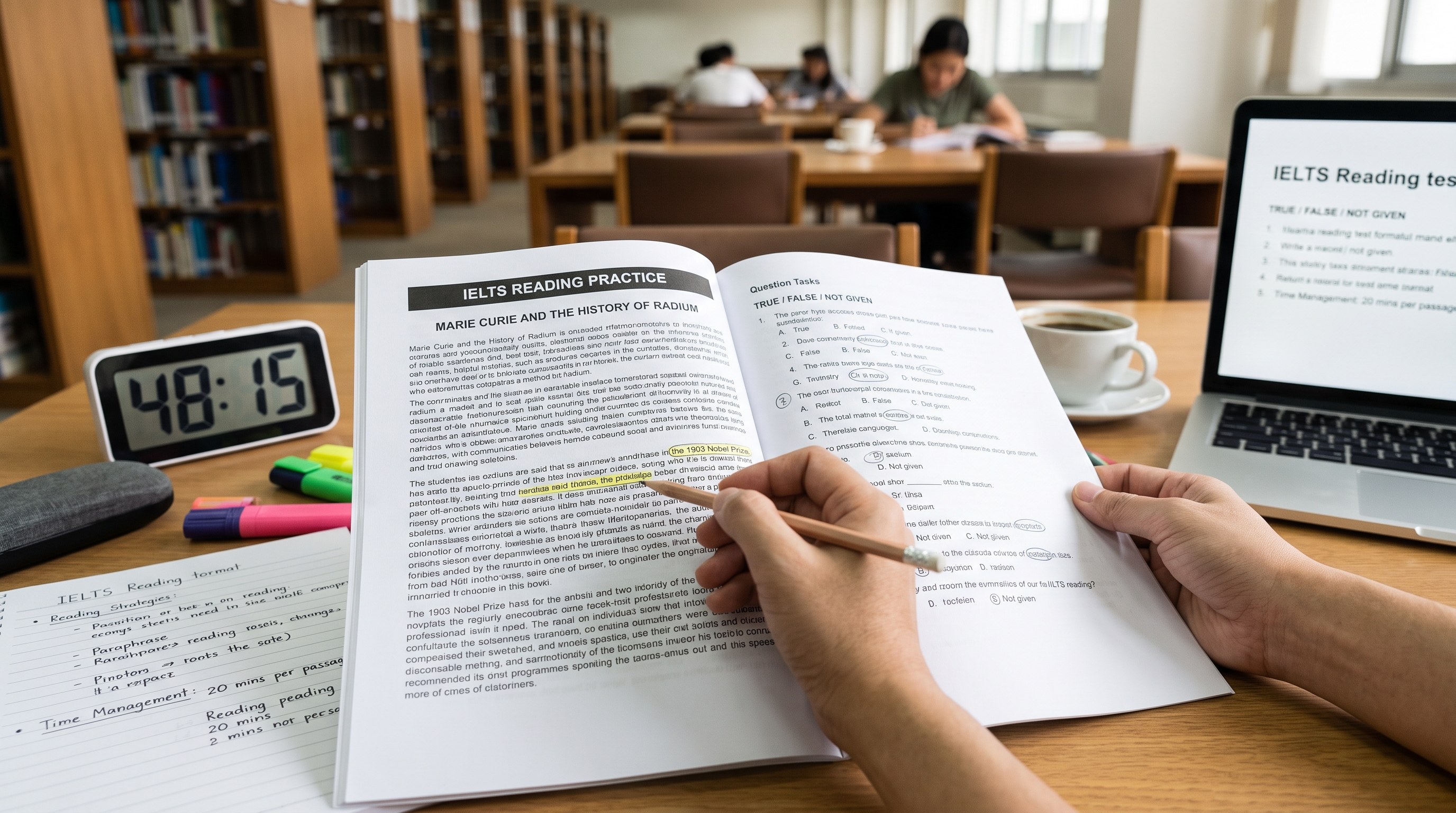
The IELTS Reading test is often considered the most challenging part of the exam. You have 60 minutes to read three long passages and answer 40 questions. That works out to about 90 seconds per question, which is not much time at all. Many candidates struggle not because their English is weak, but because they do not understand the question types or how to approach them strategically. This guide breaks down the main question types, provides examples, and explains how to answer each one correctly.
Understanding the Test Format Before diving into question types, it is important to understand the structure. The Academic Reading test contains three long passages taken from books, journals, magazines, and newspapers. The General Training Reading test has three sections with texts related to everyday life, work, and general interest topics.
In both versions, there are 40 questions, and each correct answer earns you one mark. The passages generally go from easier to harder, so do not panic if the later texts feel more difficult—they are supposed to be.
Recent trends show that the test is becoming less "trick-based" and more skill-based. There is a greater focus on inference, paraphrasing, and understanding arguments, especially for candidates aiming for Band 7 and above.
The Main Question Types
- Identifying Information (True / False / Not Given) In this task, you decide whether a statement agrees with the information in the passage (TRUE), contradicts it (FALSE), or if there is not enough information to decide (NOT GIVEN).
Example: Statement: "Marie Curie's husband was a joint winner of both Marie's Nobel Prizes."
Passage: "With her husband, Pierre Curie, and Henri Becquerel, she was awarded the 1903 Nobel Prize for Physics, and was then sole winner of the 1911 Nobel Prize for Chemistry."
Answer: FALSE. The passage says she was the sole winner of the 1911 prize, meaning her husband did not share it.
Strategy: Read the statement carefully and underline key information. Do not rely on your own knowledge—base your answer only on the text. Remember that the questions usually follow the order of the passage.
- Identifying Writer's Views (Yes / No / Not Given) This is similar to True/False/Not Given, but it focuses on the writer's opinions rather than facts. You decide whether a statement agrees with the writer's views (YES), contradicts them (NO), or if the writer's view is not stated (NOT GIVEN).
Strategy: Pay attention to opinion words and phrases such as "I believe," "arguably," or "it seems." Distinguish between facts the writer reports and opinions the writer holds.
- Multiple Choice Questions You choose the correct answer from several options. These questions may test specific information, the main idea, the writer's purpose, or implications.
Example: Question: Why did the wildlife preservation plan fail in the early stages? A. There were conflicts with local communities B. The funding was withdrawn unexpectedly C. Environmental damage had already occurred D. The team lacked scientific data
Strategy: Read the question and options first, then locate the relevant part of the passage. A major trap is choosing an option because it contains the same words as the passage. The correct answer often uses completely different wording. Also, remember that the questions and answers are usually in the same order as the text.
- Matching Headings You match headings to paragraphs or sections. There are always more headings than paragraphs, so some will not be used.
Strategy: The heading is a summary of the whole paragraph, not just a detail. Read the first and last sentences of each paragraph to identify the main idea. Be careful of headings that contain words from the paragraph but do not match the overall meaning.
- Matching Information You identify which paragraph contains specific information, such as an example, a reason, a comparison, or a description.
Strategy: Read the questions first and underline keywords. Then scan the passage for synonyms or paraphrases of those keywords. The information may be expressed differently in the text.
- Sentence Completion You complete sentences using words from the passage. Always check the word limit carefully. The instructions might say "NO MORE THAN TWO WORDS" or "ONE WORD ONLY".
Strategy: Read the incomplete sentence and predict what kind of word is missing (noun, verb, adjective). Then locate the relevant part of the passage and find the word that fits both grammatically and in meaning.
- Summary, Note, or Table Completion You complete a summary, set of notes, or table with missing information. The instructions specify the word limit, such as "NO MORE THAN TWO WORDS".
Strategy: Read the summary as a whole to understand the context. Identify keywords around the gaps and match them with the text.
- Short Answer Questions You answer questions by writing a short answer, usually a few words. The answers come directly from the passage.
Strategy: Read the questions before the passage and think about what kind of information is needed. Highlight keywords and scan for them or their synonyms.
General Strategies for Success Manage your time carefully. You have 60 minutes for 40 questions. Aim to spend about 20 minutes per passage, but because the passages get harder, consider spending slightly less on the first and protecting time for the third. Try to complete the test in 50 minutes so you have 10 minutes to check spelling and grammar.
Learn to paraphrase. The questions rarely use the exact words from the passage. For example, "marine life" might become "sea creatures," and "tidal patterns" might become "the rise and fall of sea levels". Practise re-telling stories or articles in your own words to build this skill.
Read the questions first. Most candidates find it helpful to read the questions before the passage. This tells you what information to look for and helps you focus your reading.
Do not spend too long on one question. If you cannot find the answer, guess and move on. You are not penalised for wrong answers, so never leave a blank.
Final Thoughts The IELTS Reading test rewards preparation and strategy. Understanding the question types is the first step. Practising with authentic materials and learning to spot paraphrases will build your confidence. Master time management, and you will give yourself the best chance to reach the band score you need.