
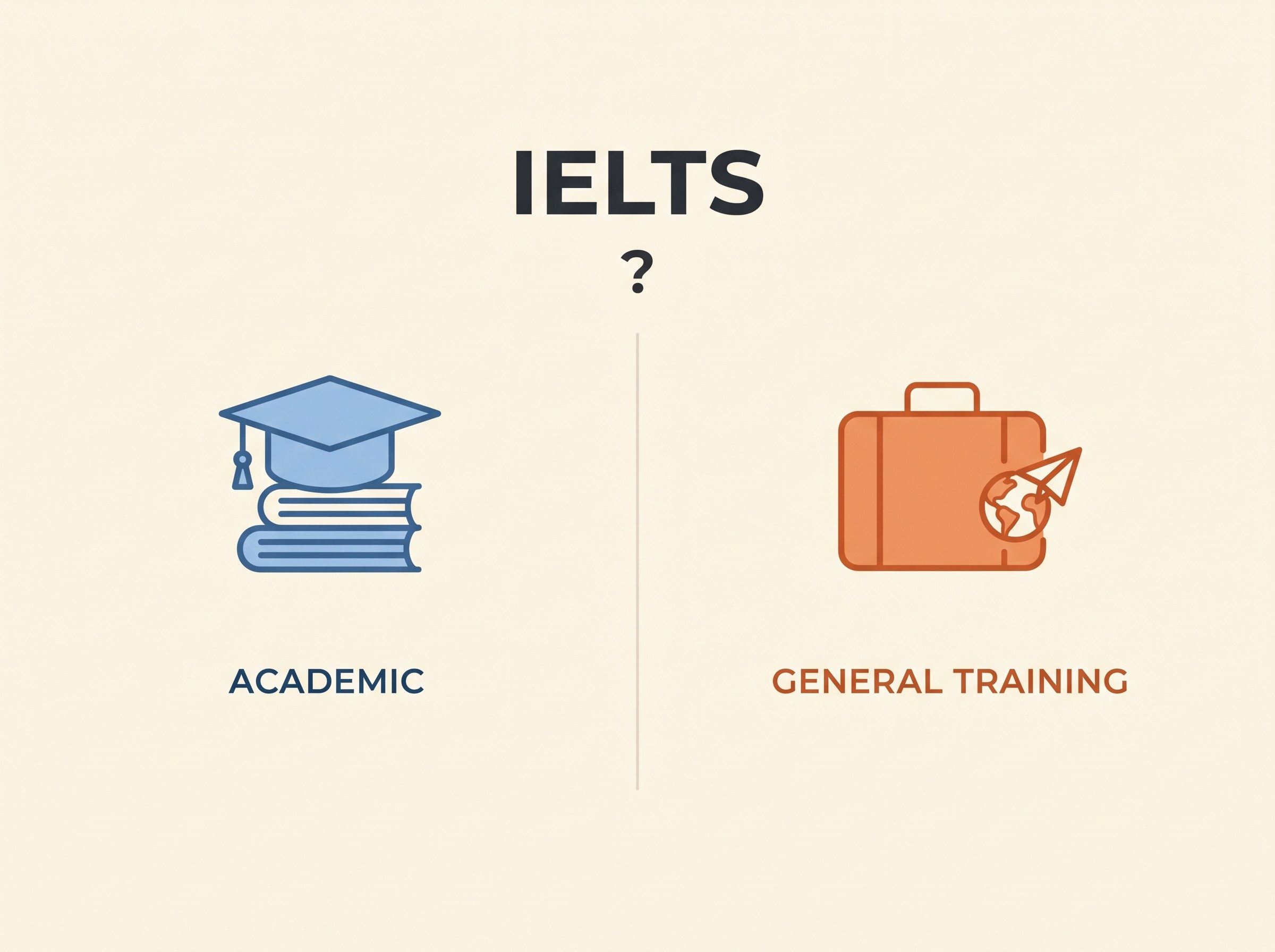
So you've decided to take IELTS. Good choice. But before you book a test date, you need to answer one question: Academic or General Training?
It sounds simple, but I've seen plenty of students waste money and months of preparation because they picked the wrong version. The two tests are not the same. They lead to different places, and they test you in different ways.
Let's sort this out once and for all.
The Short Answer
Here's the quick version if you're in a hurry:
- Academic is for university study and professional registration.
- General Training is for migration, work experience, and some visa applications.
Still with me? Let's go deeper, because the details matter.
What Is IELTS Academic?
IELTS Academic is the version you take if you want to study at a university where English is the language of instruction. It's also the one you need for professional bodies — doctors, nurses, engineers, and others who want to register and work in an English-speaking country.
The thinking behind it is straightforward. Universities and professional organizations want to know that you can handle complex reading materials, write formal essays, and follow academic arguments. So the test is built to measure exactly that.
What makes Academic different?
The Reading section uses texts taken from books, journals, and academic magazines. You'll deal with scientific topics, research summaries, and arguments that require careful reading. The vocabulary is more advanced, and the sentences are longer.
Writing Task 1 is where most people feel the difference. You're given a chart, graph, table, map, or process diagram, and you have to describe it in at least 150 words. You're not giving your opinion — you're reporting data. This trips up a lot of people who are used to writing essays.
Writing Task 2 is a formal essay of at least 250 words on a topic of general academic interest. Same task for both versions, actually, though the Academic one tends to expect a slightly more formal register.
Listening and Speaking are identical in both versions. No difference there at all.
What Is IELTS General Training?
General Training is the one you take for migration and work purposes. If you're applying for a visa to Australia, Canada, New Zealand, or the UK, there's a good chance this is what you need. It's also used for some secondary education and training programmes.
The idea here is different. Instead of testing whether you can read a research paper, General Training checks whether you can function in everyday English — reading notices, understanding workplace documents, writing letters, and handling practical situations.
What makes General Training different?
The Reading section uses texts you'd actually encounter in daily life: advertisements, company handbooks, official documents, newspaper articles, and notices. The language is more practical, though it's not necessarily "easy" — the questions still test your ability to find information quickly and accurately.
Writing Task 1 asks you to write a letter. It could be formal (to a company or official), semi-formal (to a colleague or landlord), or informal (to a friend). You need to cover three bullet points in at least 150 words. If you've ever written a complaint email or asked a friend for a favour in English, you've already got a head start.
Writing Task 2 is the same essay format as Academic — at least 250 words on a general topic.
Again, Listening and Speaking don't change.
The Real Differences, Side by Side
Let me put the key differences in one place so you can see them clearly:
Reading: Academic gives you academic texts. General Training gives you everyday texts. The question types are similar, but the content is completely different.
Writing Task 1: Academic is a data description. General Training is a letter. This is the biggest practical difference, and it's the one that catches people out.
Writing Task 2: Same essay task for both.
Listening and Speaking: Identical. No difference in format, content, or scoring.
Scoring: Here's something many people don't realise — the band scores are not directly comparable. A Band 7 in General Training Reading is easier to achieve than a Band 7 in Academic Reading, because the texts are less demanding. Universities and immigration authorities know this, which is why they set different requirements for each version.
How to Choose: Ask Yourself These Questions
Rather than guessing, work through these questions honestly.
Are you applying to a university? Then you almost certainly need Academic. Check the specific requirement of the institution, because some accept General Training for foundation or pathway programmes, but most don't.
Are you applying for a visa or permanent residency? Then it's probably General Training. But check the exact requirement for your visa category — this varies by country and even by visa type.
Are you registering with a professional body? Academic is usually the requirement. Doctors, nurses, dentists, and engineers typically need Academic.
Are you taking it for work experience or a training programme? General Training is more likely, but confirm with the organisation.
Are you unsure? Contact the institution or authority you're applying to. Don't rely on forums or guesswork. A five-minute email can save you a lot of money and stress.
The Mistake That Costs People Months
I want to flag this because it happens more often than it should.
Some candidates assume General Training is "easier" and book it without checking. Then they discover their university or visa requires Academic, and they have to start over. That's a wasted test fee, a wasted preparation period, and a lot of unnecessary frustration.
The reverse also happens. People book Academic because it sounds more prestigious, then find out their visa only needs General Training. They've made their own life harder for no reason.
Neither test is "better" than the other. They're just built for different purposes. Pick the one that matches your goal, not the one that sounds more impressive.
Can You Prepare for Both at Once?
Not really, and I wouldn't recommend trying.
The Listening and Speaking sections are the same, so you can prepare for those together. But the Reading and Writing sections diverge sharply. Academic Reading requires practice with academic texts and data interpretation. General Training Reading requires practice with everyday documents and letter writing.
Trying to prepare for both at the same time means you're splitting your energy and doing neither properly. Pick one, commit to it, and prepare with focused materials.
A Quick Word on Difficulty
People often ask which test is harder. The honest answer is: it depends on your background.
If you've been studying at university or reading academic materials in English, Academic might feel more natural. If you've been working in an English-speaking environment and writing emails all day, General Training might play to your strengths.
What's true for everyone is that both tests require serious preparation. Neither is a walk in the park. The band score you need is the real challenge, not the label on the test.
Final Checklist Before You Book
Before you pay for that test date, run through this:
1. Confirm the exact requirement with the university, employer, or immigration authority. Get it in writing if you can.
2. Check the band score requirement, not just the test type. Some institutions ask for a higher score in one skill than another.
3. Look at the test format for your chosen version and make sure you're comfortable with the task types.
4. Choose your preparation materials based on the version you're taking. Don't mix them up.
5. Book early if you have a deadline. Test slots fill up, especially in peak seasons.
The Bottom Line
IELTS Academic and General Training are two different tests with two different purposes. Academic is for university and professional registration. General Training is for migration and work. The Listening and Speaking sections are the same, but Reading and Writing are not.
The most important step is not choosing the "better" test — it's choosing the right one for your goal. Confirm the requirement, prepare for that specific version, and don't let a simple mix-up cost you time and money.
Once you've picked the right one, the rest is just preparation. And that, at least, is something you can control.