
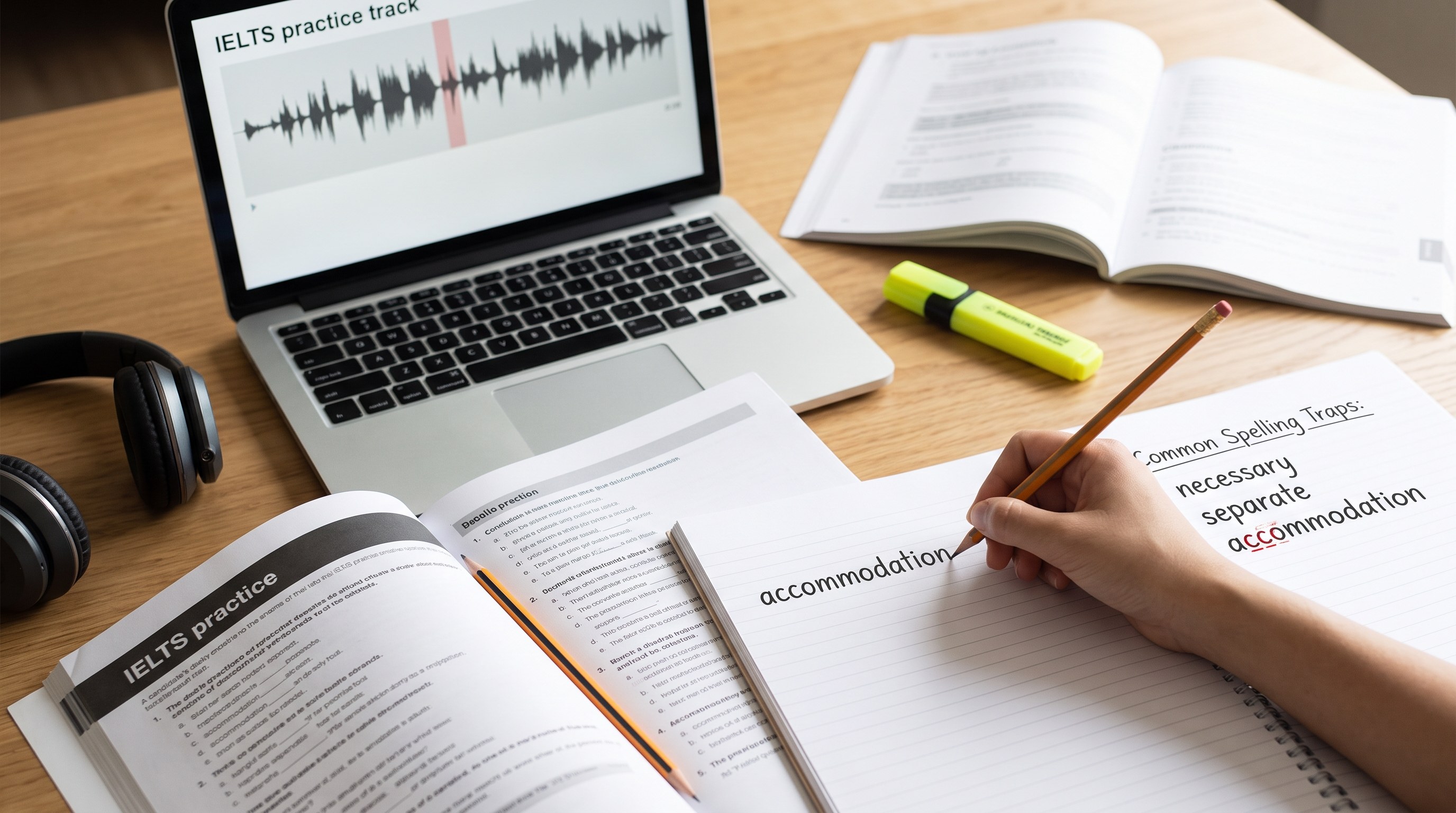
When students prepare for IELTS Listening, they often focus on question types and techniques. These are important, but there is another skill that quietly decides many answers: spelling.
Imagine you hear the word “accommodation” clearly. You know it means a place to stay. You write “accommodation” and move on. The answer is marked wrong. This happens to thousands of candidates every year. In IELTS Listening, if the spelling is wrong, the answer is wrong—even if you understood the audio perfectly.
This post looks at the vocabulary and spelling habits you need to improve your Listening score, using a practical word list that covers the most common IELTS topics.
Why Vocabulary and Spelling Matter Together
IELTS Listening tests you in real-life situations. You might hear a conversation about booking a hotel, visiting a doctor, or joining a university course. The words in these situations are predictable. If you already know them, you can listen for meaning instead of struggling with every sound.
For example, in a travel conversation, you may hear:
“Your reservation is confirmed. Please check your itinerary and keep your receipt.”
If words like reservation, itinerary, and receipt are familiar, you can focus on the answer. If they are not, you may miss the next question while still thinking about the first one.
The Core Vocabulary Groups These are exactly the topics that appear in IELTS Listening.
Travel and transport include words like passenger, platform, departure, destination, luggage, timetable, and accommodation. You might hear: “The departure time has changed. Please check the timetable on the platform.”
Shopping and payment include voucher, receipt, refund, discount, coupon, invoice, and guarantee. A speaker might say: “Keep your receipt if you want a refund.”
Hotels and accommodation include reception, reservation, facilities, balcony, checkout, and vacancy. Example: “I’m sorry, we have no vacancy tonight, but we can recommend another guesthouse.”
Health and medical includes appointment, prescription, pharmacy, treatment, symptom, insurance, and vaccination. Example: “You need an appointment before the doctor can write a prescription.”
Education includes university, laboratory, library, assignment, scholarship, certificate, and curriculum. Example: “Your assignment must be submitted to the department office by Friday.”
Jobs and people include engineer, architect, receptionist, accountant, journalist, electrician, mechanic, and consultant. Example: “The receptionist will give you the invoice.”
Food and drinks include sandwich, vegetable, dessert, biscuit, cereal, mayonnaise, cappuccino, and smoothie. Example: “I ordered a sandwich with mayonnaise and a smoothie.”
Technology and communication includes website, password, username, download, attachment, software, database, and subscription. Example: “Download the attachment and enter your password.”
There are also lists for animals, fish, shops, money, and banking. The message is simple: build vocabulary by topic. Then listen for those topics in practice tests.
Common Spelling Traps
The PDF also lists “Common IELTS Spelling Traps.” These are words that candidates often misspell, even when they hear them correctly. Here are some of the most dangerous ones:
- necessary – one c, two s
- separate – not “separate”
- environment – not “environment”
- government – not “government”
- business – not “business”
- beginning – double n
- successful – double c, double s
- accommodation – double c, double m
- restaurant – tricky vowel order
- receipt – silent p
- committee – double m, double t, double e
- definitely – no a
- immediately – double m
- temperature – not “temperature”
- convenient – not “convenient”
- address – double d, double s
- occasion – double c, single s
- recommend – double m
- embarrass – double r, double s
- millennium – double l, double n
These words are not random. They follow patterns. Group them by error type:
- Double letters: accommodation, necessary, successful, committee
- Vowel order: restaurant, environment
- Silent letters: receipt, definitely
- Endings: information, recommendation, development
- British/American spelling: programme/program, colour/color
- Plural endings: facilities, symptoms, vegetables
- Confusing sounds: effect/affect, accept/except
When you review a wrong answer, don’t just write the correct spelling. Ask: What type of error did I make? This helps you avoid the same mistake next time.
The Four-Step Practice Method
The PDF suggests a simple method that works well:
- Listen – Hear the word in context without looking at the spelling.
- Write – Write the word immediately, exactly as you hear it.
- Check – Compare with the master list and mark the error type.
- Repeat – Rewrite every missed word three times, then test it again the next day.
This method is powerful because it combines listening, writing, and review. It also builds a habit: you learn to write quickly and accurately under pressure.
For example, if you misspell accommodation as “accommodation,” you mark it as a double-letter error. You write the correct form three times. The next day, you test yourself again. If you get it right, you move on. If not, you repeat the process.
Test Yourself Before Exam Day
The PDF includes a personal spelling test. The rule is simple: do not look at the master list while testing yourself. Write the spelling you hear. Then check your answers and mark the error type.
Your target should be zero spelling errors in repeated practice before exam day. This may sound strict, but it is realistic. Most IELTS Listening answers are common words. If you can spell them automatically, you free your brain to focus on meaning, not letters.
Final Thought
IELTS Listening is not only a test of hearing. It is a test of vocabulary, spelling, and speed. The word list in the PDF gives you a clear starting point. Learn the topic groups. Study the spelling traps. Use the four-step method. Test yourself until the common words become automatic.
Spelling may feel like a small detail, but in IELTS Listening, small details decide your band score. Get the words right, and you give yourself a real chance to reach the score you need.