
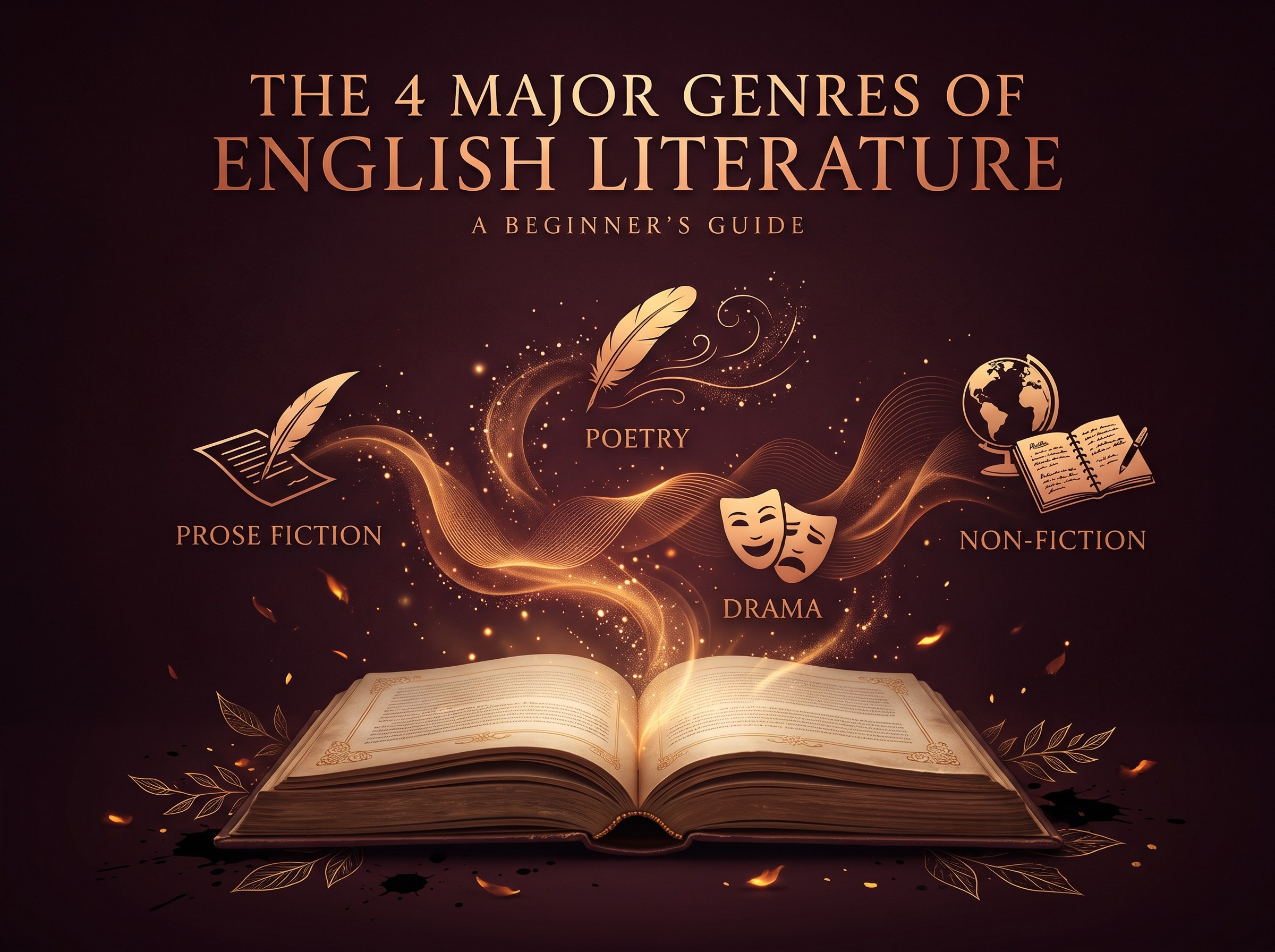
The 4 Major Genres of English Literature: A Beginner’s Guide
If you walk into a library or open an English textbook, the sheer amount of writing can feel overwhelming. You have thick novels, thin books of poems, plays with strange formatting, and essays about real events.
How do you make sense of it all?
The answer is genres.
A genre is simply a category or a type of writing. In English Literature, almost everything you will ever read, study, or be tested on falls into one of four major buckets: Prose Fiction, Poetry, Drama, and Non-Fiction.
Knowing these four genres is like having a map. It tells you what rules the writer is playing by, and it helps you understand what to look for when you read.
Let’s break down the Big Four.
1. Prose Fiction (The Storytellers)
When most people hear the word "literature," this is what they picture. Prose is everyday language written in normal sentences and paragraphs (unlike poetry, which we will get to next). "Fiction" means it is made up.
What it is: Written stories that are invented by the author.
Key Features: It focuses on characters, a plot (beginning, middle, end), a setting (where it happens), and a theme (the deeper message).
Sub-types:
- The Novel: A long work of fiction (usually over 50,000 words). Example: Pride and Prejudice by Jane Austen.
- The Short Story: A brief work of fiction meant to be read in one sitting. Example: The Gift of the Magi by O. Henry.
- The Novella: Longer than a short story, shorter than a novel. Example: Animal Farm by George Orwell.
Why it matters: Prose fiction lets us live inside someone else's life. It is the most popular form of literature because it mirrors human experience through made-up events.
2. Poetry (The Condensed Emotion)
Poetry is the oldest form of literature, and for many students, the most intimidating. But poetry is just writing that has been packed very tightly. The poet removes all the extra words to make the meaning and emotion stronger.
What it is: A highly structured form of writing that uses rhythm, imagery, and figurative language to express deep feelings or ideas.
Key Features: It is usually written in lines and stanzas (paragraphs in poetry). It relies heavily on literary devices like metaphors, similes, and alliteration.
Examples:
- Sonnet 18 by William Shakespeare ("Shall I compare thee to a summer's day?")
- The Road Not Taken by Robert Frost.
Why it matters: Poetry is not meant to be read like a normal book. It is meant to be read slowly and out loud. It captures a single, powerful moment or emotion in a way that normal sentences cannot.
3. Drama (The Performance)
Drama is literature written to be performed. You are not just reading a story; you are reading the script of a play.
What it is: A story told entirely through the dialogue and actions of characters, designed to be acted out on a stage.
Key Features: It does not have a narrator telling you what is happening. Instead, you get stage directions (instructions telling actors where to stand or how to speak) and dialogue (what the characters say to each other).
Sub-types:
- Tragedy: A serious play where the main character (the tragic hero) suffers a downfall. Example: Macbeth by William Shakespeare.
- Comedy: A play that is humorous and usually ends happily. Example: A Midsummer Night’s Dream.
Why it matters: Drama brings literature to life. It relies on conflict—whether it is a character fighting another person, fighting society, or fighting their own inner demons.
4. Non-Fiction (The Truth Tellers)
Non-fiction is literature based on facts, real events, and real people. It is the opposite of fiction.
What it is: Writing that tells the truth about reality, history, or the author's own life.
Key Features: It includes real names, dates, and events. However, just because it is factual doesn’t mean it can't be beautifully written.
Examples:
- Biography / Autobiography: The story of a person's life (written by someone else, or by themselves). Example: The Diary of a Young Girl by Anne Frank.
- Essays: Short pieces of writing about a specific topic. Example: Essays by George Orwell.
- Memoir: A collection of memories written by the author about a specific part of their life.
Why it matters: Non-fiction allows us to learn from the past, understand the world around us, and step into the real lives of others.
How to Tell Them Apart (Quick Exam Guide)
If you are in an exam and you are asked to identify the genre of a text, look at how it is formatted on the page:
Genre How to Spot It Example
Prose Fiction
Written in paragraphs. Has a narrator. Tells a made-up story.
Harry Potter
Poetry
Written in short lines and stanzas. Might have rhyming words.
Daffodils
Drama
Contains character names on the left, dialogue, and stage directions in brackets.
Julius Caesar
Non-Fiction
Written in paragraphs. Has real dates, names, and facts.
A biography of Nelson Mandela
Final Word
You do not need to love every genre. Some students love the deep emotion of poetry, while others prefer the excitement of prose fiction.
But understanding the four major genres gives you the vocabulary to talk about what you are reading. It helps you understand how the writer is trying to communicate with you. And in English Literature exams, that understanding is the key to getting top marks