
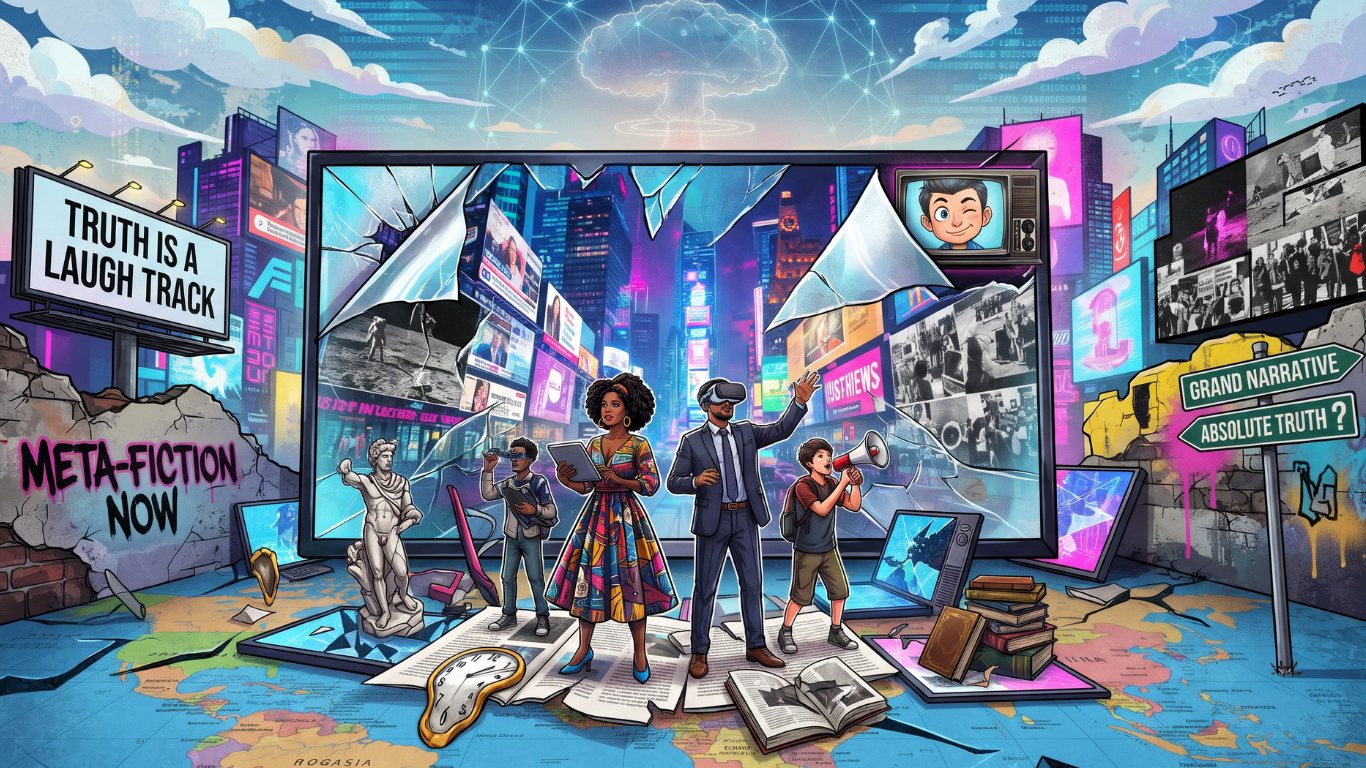
The Postmodern & Contemporary Period (1945–Present): The Age of Irony and Diversity
If the Modernists looked at the world after World War I and saw a broken mirror, the Postmodernists looked at the world after World War II and decided the mirror was an illusion anyway.
The Modernists believed that even though the world was chaotic, art could still provide meaning. They believed in deep psychology, grand myths, and the power of the artist.
The Postmodernists threw all of that out the window.
They lived through the atomic bomb, the Cold War, and the rise of mass media. They came to believe that truth is relative, that history is just a story someone made up, and that the only way to survive the absurdity of modern life is through irony, satire, and playfulness. Literature became a giant puzzle box, and the reader was never quite sure if there was a solution at the bottom.
Here is everything you need to know about the Postmodern and Contemporary Period.
Part 1: The Historical Context (A World of Shadows)
The era begins in 1945 in the smoking ruins of Europe and Japan. The world had just survived the Holocaust and the dropping of the atomic bomb. Humanity had proven it was capable of destroying itself entirely.
1. The Cold War (1947–1991)
The world was split into two massive camps: the capitalist United States and the communist Soviet Union. This was an era of constant paranoia, the threat of nuclear annihilation, and espionage. People lived in fear that a single button push could end the world.
2. Decolonization and the Post-Colonial World
After WWII, the British Empire collapsed. Countries like India (1947), Nigeria, and Kenya gained their independence. This created a massive shift in literature. For the first time, writers from Africa, the Caribbean, and South Asia began publishing their stories in English, focusing on the trauma of colonization and the struggle for identity.
3. The Technological and Media Revolution
The invention of television (and later the internet and smartphones) completely changed how humans experienced reality. People began to live in a world of images and simulations. The news, advertisements, and entertainment began to blur together.
4. The Fall of the Berlin Wall (1989) and 9/11
The fall of the Soviet Union in 1991 marked the end of the Cold War, creating a sense of "endless possibilities" that quickly turned into the paranoia of the 21st century following the 9/11 terrorist attacks.
Part 2: The Postmodern Mindset (The New Philosophy)
The Postmoderns were deeply suspicious of grand claims, absolute truths, and traditional authorities.
1. The Rejection of "Metanarratives"
A metanarrative is a grand, overarching story that tries to explain everything (e.g., Religion, Science, Marxism, Progress). The French philosopher Jean-François Lyotard famously defined postmodernism as "incredulity toward metanarratives." Postmodernists believe these grand stories are just illusions used to control people.
2. Irony and Parody
If you can't find absolute truth, you might as well laugh at the absurdity of it all. Postmodern literature is deeply ironic. It often copies older styles (pastiche) but does so in a mocking or playful way.
3. Hyperreality and Simulation
The French philosopher Jean Baudrillard argued that modern society has lost touch with reality. We live in a "hyperreality"—a world of simulations (like social media, reality TV, and theme parks) that feels more real than the real thing.
4. Identity as a Construct
Modernists focused on the deep, inner "self." Postmodernists believe that our identity is not fixed—it is shaped by language, culture, and the roles we play.
Part 3: The Rules of Postmodern Literature (The New Techniques)
Postmodern writers completely abandoned the traditional rules of storytelling. They wanted to confuse, entertain, and challenge the reader.
1. Metafiction (Breaking the Fourth Wall)
This is when a story draws attention to the fact that it is a story. The narrator might talk directly to the reader, complain about the author, or interrupt the plot to discuss philosophy.
- Example: A character in a novel suddenly realizes they are in a novel and gets angry at the author for writing a tragic ending for them.
2. Magical Realism
This is a style where impossible, magical events are described in a completely normal, matter-of-fact tone. It originated in Latin America but spread worldwide.
- Example: A character might fly to heaven while hanging up the laundry, and nobody thinks it's strange.
3. Unreliable Narrators
In Postmodern literature, you can never trust the person telling the story. The narrator might be lying, insane, or just too young to understand what is happening. The reader has to figure out the truth themselves.
4. Intertextuality
This is the blending of different texts. Postmodern writers love to take characters from old famous books and put them in new, bizarre situations.
Part 4: The Postmodern & Contemporary Novelists
The novel remains the dominant literary form, but it has exploded in diversity.
1. The British Dystopians
George Orwell (1903–1950)
While he died just as the era was beginning, Orwell’s *1984* (1949) and Animal Farm (1945) set the tone for the Postmodern fear of totalitarianism. *1984* gave us the concepts of "Big Brother," "doublethink," and "Newspeak."
Margaret Atwood (1939–Present)
A Canadian writer known for her brilliant, dark speculative fiction. Her masterpiece, The Handmaid's Tale (1985), is a terrifying look at a future where women are stripped of their rights and forced into reproductive slavery. It remains one of the most important feminist texts ever written.
2. The Postmodern Masters (Mixing Genres)
Kazuo Ishiguro (1954–Present)
A British-Japanese novelist who won the Nobel Prize in Literature. He is a master of the unreliable narrator.
- The Remains of the Day (1989): An English butler looks back on his life and realizes he has wasted it serving a Nazi-sympathizing master, hiding his deep regrets behind a wall of polite denial.
- Never Let Me Go (2005): A chilling, quiet science fiction novel about cloned children raised to donate their organs.
Salman Rushdie (1947–Present)
An Indian-British writer who revolutionized post-colonial literature. He uses magical realism and wild, energetic language to tell the history of India.
- Midnight's Children (1981): A brilliant novel about a boy born at the exact moment of India's independence, whose life becomes magically linked to the fate of the nation.
J.R.R. Tolkien (1892–1973)
He bridged the gap between Modernism and Postmodernism. His The Lord of the Rings trilogy (published in the 1950s) practically invented modern fantasy literature and established the concept of "world-building."
J.K. Rowling (1965–Present)
A defining figure of the contemporary era. The Harry Potter series brought mass-market children's literature back into the mainstream and created a massive global cultural phenomenon.
Part 5: The Postmodern & Contemporary Poets
Poetry has become highly diverse, moving away from strict academic forms and focusing on personal identity, politics, and raw emotion.
1. The Confessional Poets
They poured their deepest, darkest personal traumas into their poetry.
- Sylvia Plath (1932–1963): A brilliant, tragic American poet. Her collection Ariel features poems like Daddy and Lady Lazarus, which deal with her turbulent relationship with her father, her mental illness, and her suicide attempts.
- Ted Hughes (1930–1998): Plath's husband. He wrote harsh, brutal poems about nature and animals, reflecting his complex psychological state.
2. The Postcolonial Voice
Derek Walcott (1930–2017): A Caribbean poet who won the Nobel Prize. He wrote massive epic poems blending the history of the Caribbean, the legacy of slavery, and the beauty of the islands.
Seamus Heaney (1939–2013): An Irish poet who won the Nobel Prize. He wrote deeply about the history of conflict in Northern Ireland, family, and the earthy reality of rural life.
3. Performance Poetry and Slam
In the 21st century, poetry has moved back to its oral roots. Spoken word artists, rappers, and "Insta-poets" (like Rupi Kaur) have made poetry massively popular again, focusing on short, accessible, and deeply emotional verses.
Part 6: The Theatre of the Absurd (Modern Drama)
After the trauma of WWII, a group of playwrights decided that traditional, logical plays (where people talk normally and things make sense) were dead. If the world is meaningless, why should plays make sense?
The Theatre of the Absurd was born. The plays feature illogical plots, circular dialogue, and characters who are trapped in meaningless situations.
1. Samuel Beckett (1906–1989)
An Irish writer who wrote in both English and French. His masterpiece is Waiting for Godot (1953).
- The Plot: Two men, Vladimir and Estragon, sit by a tree, waiting for a man named Godot to arrive. They argue, tell jokes, and talk about their boots. Godot never arrives. The play ends exactly where it started. It is a brilliant, hilarious, and terrifying metaphor for the meaninglessness of human existence.
2. Harold Pinter (1930–2008)
Pinter wrote plays about the "comedy of menace." His characters talk constantly, but they are not really communicating. They use language to hide the truth and threaten each other. He is famous for "Pinter pauses"—long, uncomfortable silences in his dialogue.
3. Tom Stoppard (1937–Present)
Stoppard is a brilliant intellectual playwright. His most famous play, Rosencrantz and Guildenstern Are Dead (1966), is a perfect example of Postmodernism. It takes two minor, unimportant characters from Shakespeare's Hamlet and makes them the heroes of their own absurd, philosophical journey.
Part 7: The Contemporary Era (The 21st Century)
In the 2000s and 2020s, literature has become deeply affected by the internet, globalization, and the climate crisis.
- Digital Literature: Writers now use hypertext, interactive fiction, and AI to create stories. E-books and audiobooks have changed how we consume novels.
- Diversity and Own Voices: The publishing industry has seen a massive push for writers of color, LGBTQ+ writers, and disabled writers to tell their own stories.
- Climate Fiction (Cli-Fi): A new genre exploring the catastrophic effects of climate change (e.g., The Ministry for the Future by Kim Stanley Robinson).
- The Short Attention Span: With social media, readers are drawn to short, punchy essays, flash fiction, and poetry that can be consumed on a phone screen.
Quick Summary: Exam Cheat Sheet
- Time Period: 1945 – Present.
- Historical Context: WWII, the atomic bomb, the Cold War, Decolonization, the internet, and 9/11.
- Key Philosophies: Rejection of absolute truth (metanarratives), irony, hyperreality, and the instability of identity.
- Major Literary Techniques: Metafiction, Magical Realism, Unreliable Narrators, and Pastiche.
- The Big Novelists: George Orwell (*1984*), Margaret Atwood (The Handmaid's Tale), Salman Rushdie (Midnight's Children), Kazuo Ishiguro (The Remains of the Day).
- The Big Poets: Sylvia Plath (Ariel), Seamus Heaney, and the rise of Spoken Word.
- The Big Playwrights: Samuel Beckett (Waiting for Godot) and Harold Pinter.
- Major Themes: The absurdity of existence, the danger of totalitarianism, identity politics, and the blurring of reality and simulation.