
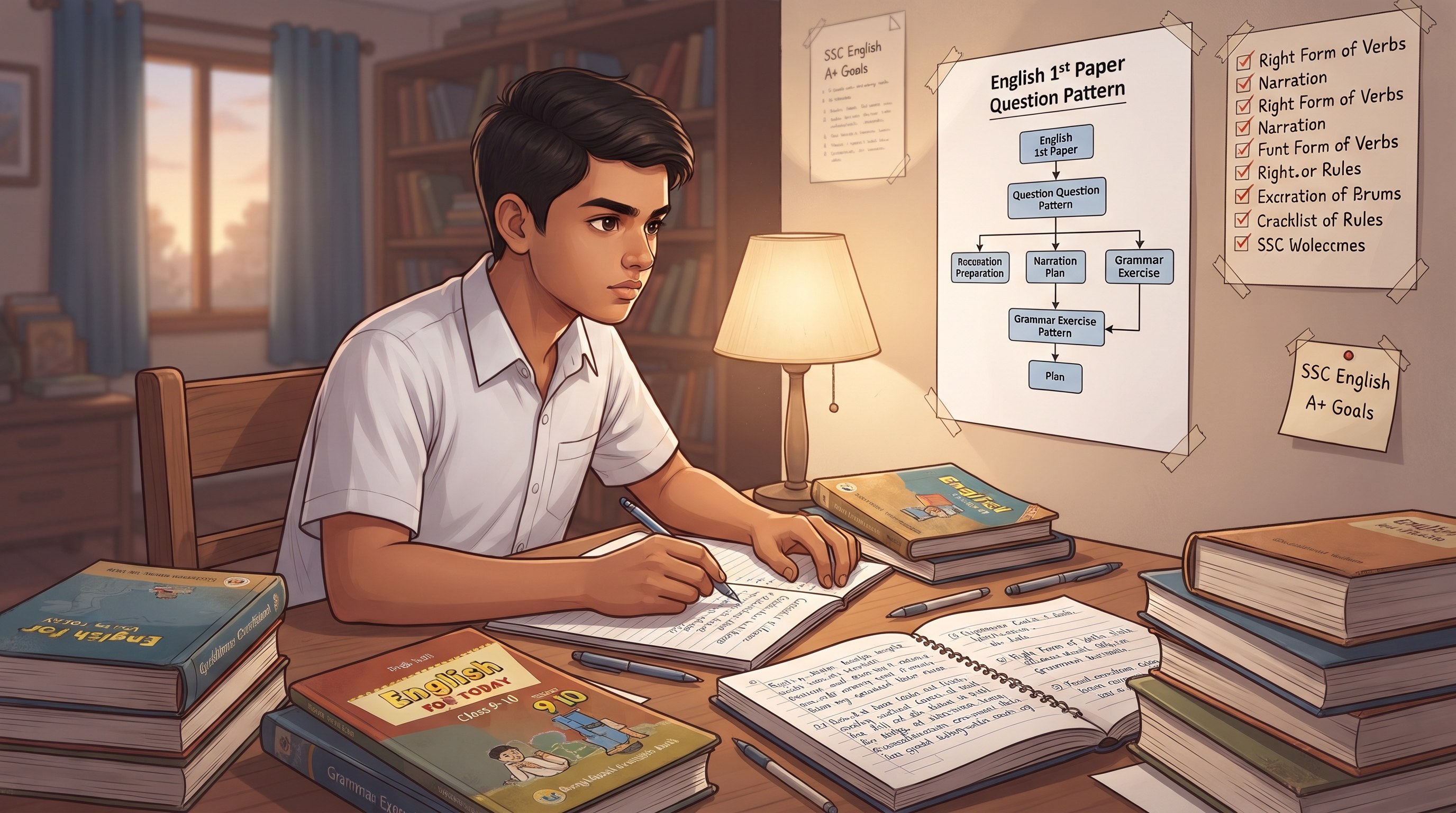
The Ultimate Guide to SSC Academic English in Bangladesh: Syllabus, Strategies, and Secrets to an A+
For SSC candidates in Bangladesh, English is often the most intimidating subject. Unlike other subjects, there are no "creative questions" (সৃজনশীল প্রশ্ন) in English. It is entirely skills-based. You cannot memorize your way to an A+; you have to understand the rules and the question patterns.
Many students lose marks simply because they prepare based on old guidebooks or outdated suggestions. The question pattern has changed. If you walk into the exam hall expecting the old format, you will be caught off guard.
Here is the complete, up-to-date roadmap for both English 1st Paper and English 2nd Paper.
Part 1: English 1st Paper (Reading & Writing) – 100 Marks
The 1st Paper tests your comprehension and writing skills. It is divided into two parts: Part A: Reading (70 Marks) and Part B: Writing (30 Marks). You must answer a total of 11 questions.
Part A: Reading Test (70 Marks)
This section is a race against time. You have to read passages, extract information, and answer questions quickly and accurately.
1. Seen Comprehension (Questions 1, 2, and 3)
These questions are based on the passages from your English for Today textbook.
- Question 1: Multiple Choice Questions (MCQ) (7 Marks) You will get 7 MCQs based on a seen passage. Each question has 4 options. You must select the most accurate one based strictly on the text.
- Question 2: Answering Questions (10 Marks) You will get 5 questions based on the same seen passage. You need to answer these in 2 or 3 sentences using your own words. This tests your comprehension and analytical skills. (5 × 2 = 10 Marks)
- Question 3: Gap Filling (5 Marks) You will be given a passage with 5 blanks. You must fill in the blanks with appropriate words based on the context of the passage. (5 × 1 = 5 Marks)
2. Unseen Passage (Questions 4 and 5)
This passage will not be from your textbook. It tests your ability to read and understand a completely new text.
- Question 4: Information Transfer (5 Marks) You must read the unseen passage and transfer specific information into a table or chart. You need to write the answers in short phrases, not full sentences. (5 × 1 = 5 Marks)
- Question 5: Summary Writing (10 Marks) You must write a summary of the unseen passage. The summary should be exactly one-third of the original passage. Use your own words, indirect speech, and simple sentences. (10 Marks)
3. Matching and Rearranging (Questions 6 and 7)
- Question 6: Matching (5 Marks) You will be given three columns containing parts of sentences. You must match the parts from the three columns to form 5 meaningful sentences. (5 × 1 = 5 Marks)
- Question 7: Rearranging Sentences (8 Marks) You will be given 8 jumbled sentences. You must rearrange them to form a coherent, meaningful story or paragraph. You just need to write the serial numbers in the correct order. (8 × 1 = 8 Marks)
4. Poem and Story (Questions 8 and 9)
- Question 8: Poem (10 Marks) You will be given questions based on a poem from your textbook. There will be 8 questions, and you must answer any 5. (5 × 2 = 10 Marks)
- Question 9: Story (10 Marks) You will be given questions based on a story from your textbook. There will be 8 questions, and you must answer any 5. (5 × 2 = 10 Marks)
Part B: Writing Test (30 Marks)
This section tests your ability to produce original, grammatically correct writing.
- Question 10: Completing a Story (15 Marks) You will be given the beginning of a story. You must complete it logically in at least 10 sentences and give it a suitable title and a moral at the end.
- Question 11: Dialogue Writing (15 Marks) You will be asked to write a dialogue between two people on a given topic (e.g., the importance of reading books, the benefits of physical exercise). You need to write 5-6 turns (pairs of exchanges).
Part 2: English 2nd Paper (Grammar & Composition) – 100 Marks
This paper is the most feared but highly predictable. It tests the literal rules of the English language. It is divided into Part A: Grammar (60 Marks) and Part B: Composition (40 Marks). You must answer 15 questions.
Part A: Grammar (60 Marks)
This section has 11 questions. Accuracy and speed are key here.
- Question 1: Gap Filling with Clues (5 Marks) – A passage with 10 blanks. A box with 10 words is given. You must use the correct form of the words (changing parts of speech if necessary). (0.5 × 10 = 5 Marks)
- Question 2: Gap Filling without Clues (5 Marks) – A passage with 10 blanks. No words are given. You must use appropriate prepositions, articles, and parts of speech. (0.5 × 10 = 5 Marks)
- Question 3: Substitution Table (5 Marks) – A three-column table with subjects, verbs, and predicates. You must match them to form 5 grammatically correct sentences. (1 × 5 = 5 Marks)
- Question 4: Right Form of Verbs (5 Marks) – A passage with 10 blanks. A box with verbs is given. You must use the correct tense, voice, and subject-verb agreement. (0.5 × 10 = 5 Marks)
- Question 5: Passage Narration (5 Marks) – Change a given passage from direct speech to indirect speech. (1 × 5 = 5 Marks)
- Question 6: Changing Sentences (10 Marks) – Change 10 sentences according to the instructions in brackets (e.g., change of voice, degree, affirmative/negative). (1 × 10 = 10 Marks)
- Question 7: Completing Sentences (5 Marks) – Complete 5 incomplete sentences using clauses or phrases. (1 × 5 = 5 Marks)
- Question 8: Tag Questions (5 Marks) – Add the correct tag questions to 5 given statements. (1 × 5 = 5 Marks)
- Question 9: Suffixes and Prefixes (5 Marks) – Fill in 10 blanks by adding appropriate suffixes or prefixes to the root words. (0.5 × 10 = 5 Marks)
- Question 10: Connectors (5 Marks) – Fill in 5 blanks with appropriate linking words (e.g., however, therefore, moreover). (1 × 5 = 5 Marks)
- Question 11: Capitalization and Punctuation (5 Marks) – Rewrite a passage using correct punctuation marks and capital letters. (5 Marks)
Part B: Composition (40 Marks)
- Question 12: Writing CV (8 Marks) – Write a Curriculum Vitae (CV) with a cover letter for a specific job application.
- Question 13: Informal Letter or Email (10 Marks) – Write a letter or email to a friend or relative.
- Question 14: Paragraph Writing (10 Marks) – Write a paragraph of around 150-200 words on a given topic.
- Question 15: Composition (12 Marks) – Write a short composition or essay of around 250 words on a given topic.
Part 3: The Ultimate Exam Hall Strategy (Time Management)
The biggest reason students fail SSC English is not a lack of knowledge; it is poor time management. If you spend 45 minutes on the Reading passage, you will not have time for the Writing section, and you will lose 30 easy marks.
Here is the perfect time breakdown for your 3-hour exam:
SectionTime AllowedWhat to Do
Reading Time
First 10 minutes
Read all the questions first. Understand what the passage is about. Do not write anything yet.
Grammar (2nd Paper) / Reading (1st Paper)
60 Minutes
Do the quick, mechanical questions first. Do not get stuck on a single MCQ or grammar rule.
Writing Section
80 Minutes
Read the prompts. Choose the easiest options. Spend 15 minutes on the paragraph, 20 minutes on the essay/story, and 15 minutes on the letter/application.
Review Time
Last 10 Minutes
Check your handwriting. Check for spelling mistakes. Make sure you have answered every question.
Part 4: The Biggest Mistakes SSC Students Make
- Relying on Guidebooks: Guidebooks are good for checking if your answer is right. They are terrible for learning. If you memorize a guidebook essay on "The Padma Bridge," and the exam asks about "Climate Change," you are finished. Learn the method, not the answer.
- Ignoring the Exact Question Pattern: Many students still prepare for old question types. Make sure you are practicing the exact 11-question pattern for 1st Paper and the 15-question pattern for 2nd Paper.
- Writing Too Much: In the Writing section, quality beats quantity. An essay of 250 beautiful, grammatically correct words will score higher than an essay of 500 words full of spelling mistakes and wrong tenses.
- Skipping the Format: In letters, applications, and reports, the format is worth up to 3 marks. Memorize the exact layout.
Final Word
The SSC English exam is challenging, but it is completely predictable. The questions follow a specific pattern every year.
Do not panic. Focus on learning the grammar rules so well that they become instinctive. Practice writing on a wide variety of topics so you are never caught off guard. And on the day of the exam, manage your time carefully.
If you follow this roadmap, an A+ is not just a dream; it is a mathematical certainty.