
The English Renaissance (1500–1660): The Golden Age of Literature
Imagine a world where the church controls everything you read, the king has absolute power, and the world is suddenly getting much, much bigger.
This was England during the Renaissance.
The word "Renaissance" means "Rebirth." For a thousand years (the Middle Ages), European art and writing focused almost entirely on God, heaven, and religion. But during the Renaissance, people suddenly looked back at the ancient civilizations of Greece and Rome. They became obsessed with human potential, beauty, science, and the physical world.
It was an age of extreme brilliance and extreme danger. It gave us William Shakespeare, the modern theatre, and the sonnet.
Here is everything you need to know about the English Renaissance.
Part 1: The Historical Context (What was happening?)
To understand the literature, you first need to understand the chaos of the time. The Renaissance in England was not a peaceful era; it was a time of religious war, political plotting, and constant fear.
1. The Tudor Dynasty and the Reformation
The Renaissance began with the Tudor dynasty. It reached a turning point under King Henry VIII.
Henry was a Catholic, but he desperately wanted a male heir. When the Pope refused to annul his marriage to his first wife, Henry made a radical decision. In 1534, he broke away from the Roman Catholic Church and created the Church of England (Protestant).
This was a massive earthquake. It destroyed the old religious order. Monasteries were shut down, and the Bible was translated into English. Suddenly, England was divided between Catholics and Protestants, and writers had to be very careful about what they wrote about religion.
2. The Elizabethan Era: The Golden Age (1558–1603)
When Henry’s daughter, Queen Elizabeth I, took the throne, England was on the brink of civil war. But she stabilized the country. She was highly educated and loved the theatre.
In 1588, England defeated the Spanish Armada (a massive invasion fleet from Catholic Spain). This victory gave the English people a massive boost of national pride. Writers praised Elizabeth as a goddess, and the arts exploded. This is why the era is often called the Elizabethan Age.
3. The Jacobean Era (1603–1625)
Elizabeth died without an heir, so the Scottish King James VI became James I of England. This is called the Jacobean era (from the Latin for James).
The mood changed. It became darker and more cynical. The relationship between the King and Parliament became very hostile, leading to deep political tension.
4. The Civil War and the End (1642)
The tension finally exploded into the English Civil War. The King (Charles I) was executed, and a strict, religious group called the Puritans took control of the country under Oliver Cromwell. The Puritans believed that theatre and fancy poetry were sinful. In 1642, they officially closed all the theatres in London. The Renaissance was officially dead.
Part 2: The Renaissance Mindset (How people thought)
To understand the characters in a Shakespeare play, you have to understand how people in this era viewed the universe.
1. Humanism (The Power of People)
Humanism was the core philosophy of the era. Instead of just focusing on heaven, writers started focusing on humans. They believed that humans were capable of amazing things. They studied human nature, logic, and history. This is why Shakespeare’s characters (like Hamlet) are so complex—they are deeply human.
2. The Great Chain of Being (The Cosmic Ladder)
This was the strict social and cosmic hierarchy that everyone believed in:
- God and Angels (Top)
- The King (God's chosen representative on Earth)
- The Nobility
- The Common People
- Animals, Plants, and Rocks (Bottom)
Why this matters in literature: If you disrupted this chain—by murdering the king, rebelling against your parents, or trying to rise above your social class—you didn't just commit a crime. You broke the universe. This is the exact theme of Shakespeare's Macbeth. Macbeth kills the king, and nature goes crazy (horses eat each other, the weather turns dark) because the natural order has been destroyed.
Part 3: The Golden Age of Drama (The Theatre)
Before the Renaissance, England had no permanent theatres. This era gave birth to the public theatre, and it became the most popular form of entertainment.
The Physical Reality of the Theatre
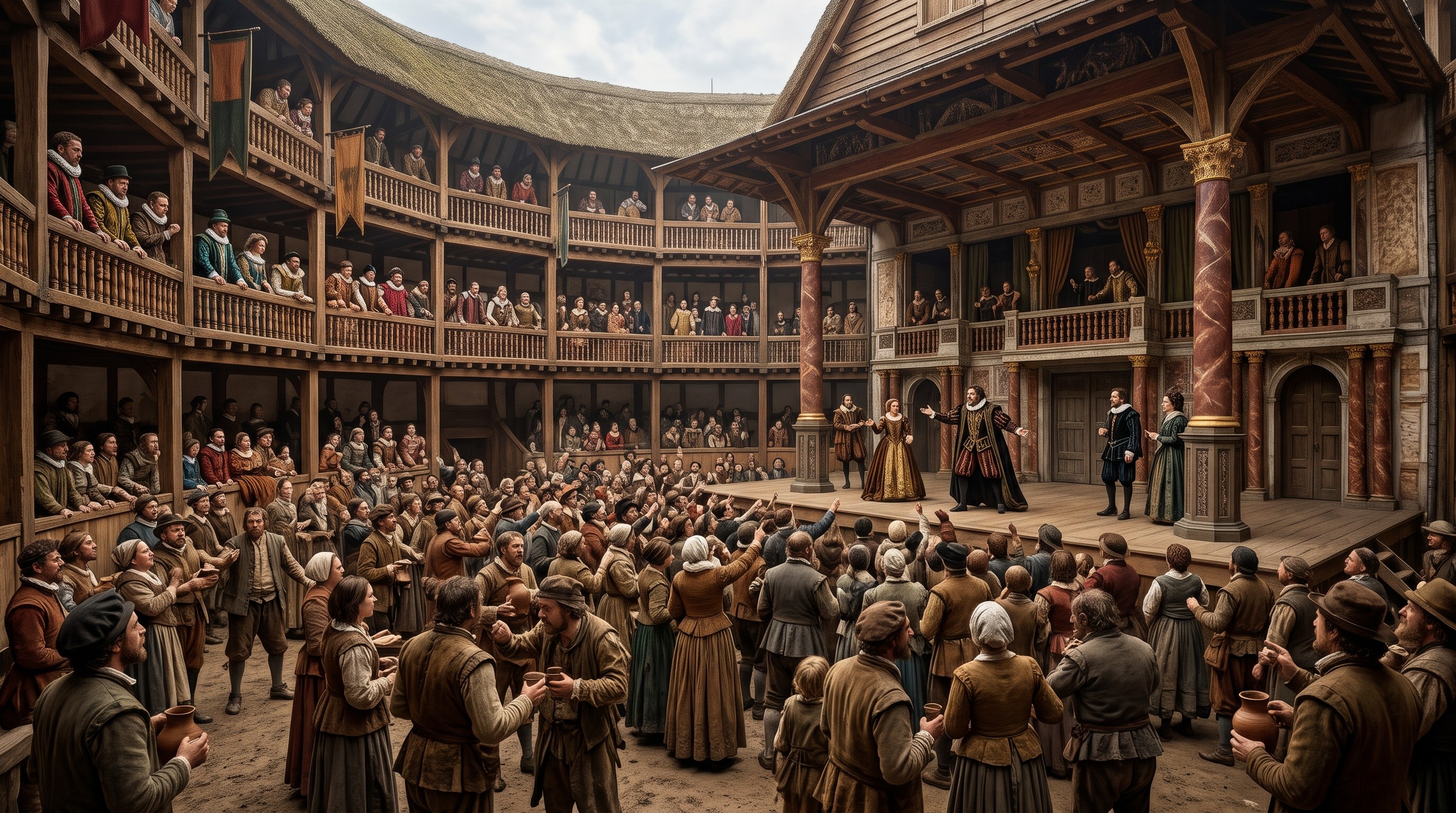
The most famous theatre was The Globe (built in 1599). It was a wooden, open-air structure.
- The Groundlings: For one penny, the poorest people stood on the dirt floor directly in front of the stage. They were loud, rowdy, and often threw nuts at the actors.
- The Galleries: For more money, the rich sat in covered seats around the edge.
- The Actors: Women were not allowed to act. All female roles (like Juliet) were played by young boys.
Blank Verse (The Sound of the Stage)
Playwrights used a new form of poetry called Blank Verse. It is poetry written with a specific rhythm (usually ten syllables per line), but it does not rhyme at the end of the lines.
- Why use it? Because it sounds like normal human speech, but it has a beautiful, elevated rhythm. It made the characters sound grand and poetic without sounding unnatural.
The Big Playwrights
1. William Shakespeare (1564–1616)
The greatest writer in the English language. He wrote 37 plays. His plays are divided into:
- Tragedies: Serious plays where the hero dies in the end (Hamlet, Macbeth, King Lear).
- Comedies: Funny plays that usually end in a marriage (A Midsummer Night's Dream).
- Histories: Plays based on real English kings (Henry V).
2. Christopher Marlowe (1564–1593)
Shakespeare's biggest rival. He was a spy and a brawler, and he died young in a bar fight. He perfected blank verse. His masterpiece is Doctor Faustus, the terrifying story of a scholar who sells his soul to the devil.
3. Ben Jonson (1572–1637)
A highly educated writer who wrote brilliant, funny satires making fun of human greed (like Volpone).
Part 4: The Age of Poetry
Poetry was highly formal and read at court.
1. The Sonnet
A sonnet is a 14-line poem with a strict rhyme scheme. It was the most popular poetic form of the era.
- The Petrarchan Sonnet: Named after the Italian poet Petrarch. It has an 8-line section (octave) and a 6-line section (sestet).
- The Shakespearean Sonnet: Shakespeare changed the format. It has three 4-line sections (quatrains) and a final 2-line section (couplet). The final couplet usually delivers a powerful punchline.
2. The Metaphysical Poets
Toward the end of the era, a group of poets led by John Donne emerged. They wrote intellectual, complex poetry.
They are famous for using a Conceit—a highly unusual, extended metaphor that compares two completely unrelated things.
- Example: Donne compares two lovers to the two legs of a drawing compass. One stays in the center, and the other circles around it, proving their eternal connection.
Part 5: The Rise of Prose
While drama and poetry dominated, prose (writing in normal sentences) also changed rapidly.
1. Sir Thomas More's Utopia (1516)
This book invented the word "Utopia" (an ideal, perfect society). It describes a fictional island where there is no private property and no poverty. It was a subtle critique of how corrupt England had become.
2. Francis Bacon's Essays (1597)
Bacon is considered the father of the English essay. His essays are short, practical, and packed with wisdom about politics, ambition, and how to succeed in life.
3. The King James Bible (1611)
King James commissioned a new English translation of the Bible. This book had a massive impact on the English language. Phrases like "the powers that be," "salt of the earth," and "a labor of love" all entered everyday speech directly from this book.
Part 6: The Forgotten Voices (Women in the Renaissance)
The Renaissance was a deeply patriarchal society. Women were generally not allowed to act, attend school, or publish books.
However, a few brilliant women broke the rules. Mary Sidney Herbert was the first English woman to achieve a major literary reputation. She translated complex biblical psalms into beautiful English poetry. Aemilia Lanyer became the first English woman to publish a volume of original poetry, arguing for the spiritual equality of women.
Quick Summary: Exam Cheat Sheet
If you need to remember the English Renaissance for an exam, memorize these core points:
- Time Period: 1500 – 1660.
- Historical Context: The Tudor dynasty, the Protestant Reformation, Queen Elizabeth I, and the English Civil War.
- Key Philosophies: Humanism and The Great Chain of Being.
- The Big Writer: William Shakespeare (Hamlet, Macbeth).
- Other Major Figures: Christopher Marlowe (Doctor Faustus), John Donne (Metaphysical poetry), Edmund Spenser.
- Major Literary Forms: The Sonnet, Blank Verse, and the public Theatre (The Globe).
- The End: The Puritans close the theatres in 1642.