
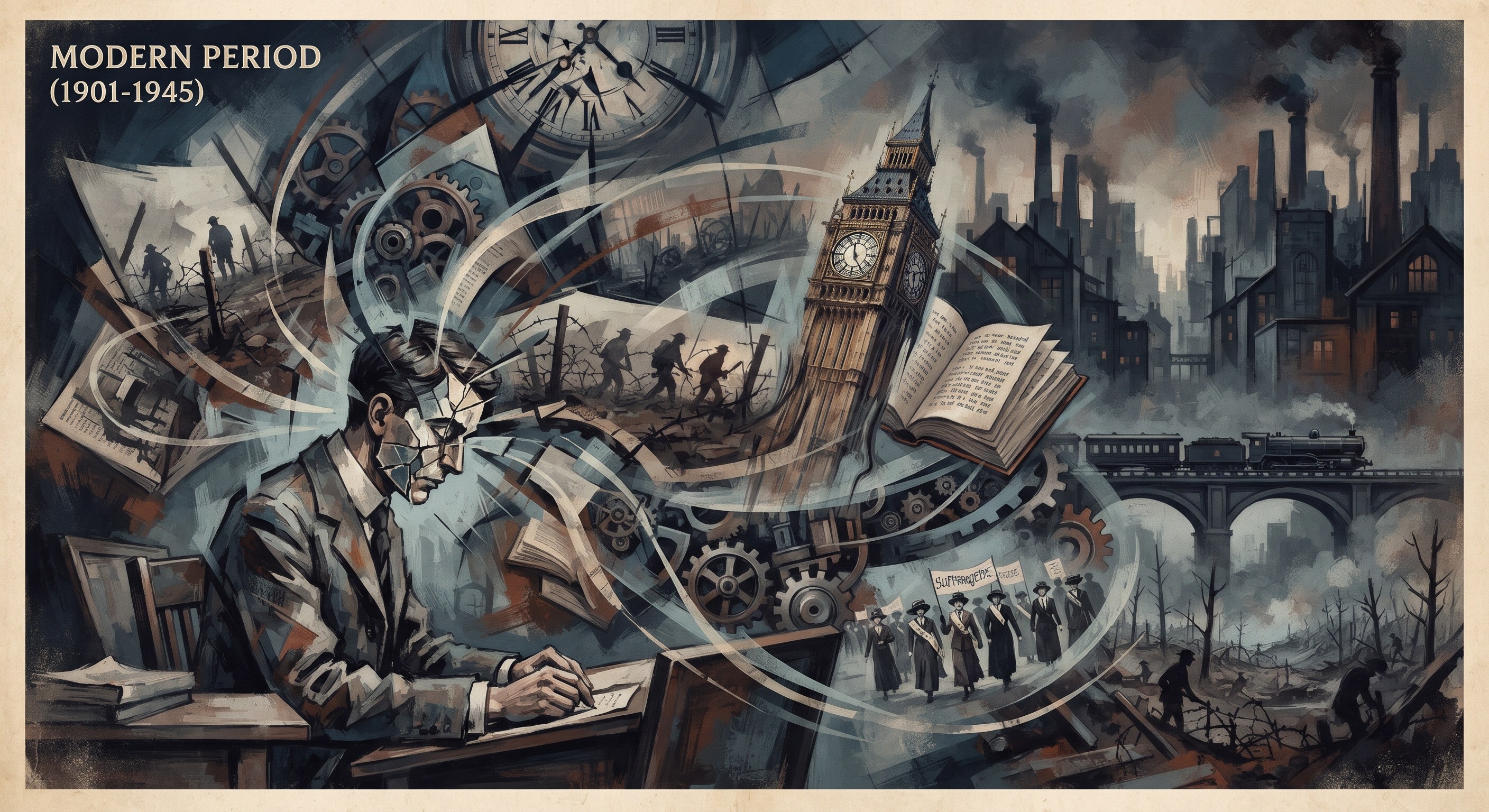
The Modern Period (1901–1945): The Age of Fragmentation and Experimentation
If the Victorian era was an age of strict rules, grand empires, and confident moral certainty, the Modern Period was the exact opposite. It was an age of shattered illusions, deep psychological trauma, and radical experimentation.
The Modernists believed that the old ways of writing could no longer explain the chaos of the 20th century. How could you write a neat, happy Victorian novel after witnessing millions of young men slaughtered in the mud of World War I? How could you write a traditional love poem after reading about the horrors of chemical warfare?
The Modernists looked at the world and saw a broken mirror. Instead of trying to glue it back together, they wrote about the broken pieces. They threw out the old rules of literature—linear plots, rhyming poetry, and neat endings—and invented entirely new ways to capture the messy, confusing reality of modern life.
Here is everything you need to know about the Modern Period.
Part 1: The Historical Context (The Death of the Old World)
To understand Modernist literature, you must understand the sheer level of trauma the world experienced between 1901 and 1945.
1. World War I (1914–1918): The Great Shattering
This is the single most important event of the era. The Victorian generation believed that war was a noble, glorious adventure. World War I destroyed that lie forever.
- The Reality of the Trenches: Soldiers fought in deep, muddy trenches, surrounded by rats, disease, and decaying bodies. New weapons—machine guns, poison gas, tanks, and heavy artillery—killed men by the millions.
- The Lost Generation: A generation of young men was physically or psychologically destroyed. Writers of this era became deeply cynical about patriotism, religion, and the government that sent them to die.
2. The Collapse of the British Empire
After the war, the British Empire began to unravel. The colonies started demanding independence. England was no longer the undisputed global superpower, and the British people had to grapple with their declining status.
3. The Rise of Totalitarianism and World War II
The economic depression of the 1930s led to the rise of dangerous dictators like Hitler in Germany and Stalin in the Soviet Union. The threat of fascism and communism terrified the world, eventually leading to the horrors of World War II (1939–1945), the Holocaust, and the atomic bomb.
4. The Women’s Suffrage Movement
During the late 19th and early 20th centuries, women fought relentlessly for the right to vote. The "Suffragettes" held massive protests, went on hunger strikes, and faced police brutality. This movement fundamentally changed the role of women in society and literature.
Part 2: The Modernist Mindset (The New Philosophy)
The Modernists were heavily influenced by radical new thinkers who changed how humanity understood reality.
1. Sigmund Freud and Psychoanalysis
Freud revolutionized the understanding of the human mind. He argued that we are not driven by logic, but by hidden, unconscious desires (especially related to sex and aggression).
- Impact on Literature: Writers became obsessed with the inner world of their characters. They stopped writing about what characters did and started writing about what they thought and felt in their deepest, darkest subconscious.
2. Albert Einstein and the Theory of Relativity
Einstein proved that time and space are not absolute—they are relative.
- Impact on Literature: Writers realized that a single day in the life of one person could contain just as much drama as a hundred years. Time in Modernist literature becomes fluid; it jumps back and forth between past, present, and future.
3. Karl Marx and Class Struggle
Marx argued that society is a constant battle between the rich (the bourgeoisie) and the working class (the proletariat).
- Impact on Literature: Writers began to explore the realities of poverty, capitalism, and the exploitation of the working class in a much more political way.
4. The Loss of Faith
Darwin had already shaken religion in the Victorian era, but World War I killed it for many. The Modernists lived in a world where God was silent, and humans had to find their own meaning in a meaningless, chaotic universe.
Part 3: The Rules of Modernist Literature (The New Techniques)
Modernist writers completely broke the rules of traditional literature. They wanted to make it new. If you are analyzing a Modernist text, look for these specific techniques:
1. The Stream of Consciousness
This is the most famous technique of Modernist fiction. Instead of writing a neat, grammatical paragraph, the writer tries to capture the exact, unfiltered flow of a character's thoughts.
- It jumps from random memories, to sensory details, to random anxieties, to sudden judgments. It is messy, chaotic, and exactly how the human brain actually works. (Famous example: Virginia Woolf's Mrs Dalloway).
2. Fragmentation and Non-Linear Plots
Victorian novels usually had a clear beginning, middle, and end. Modernist novels often start in the middle of a thought, jump backward in time, and end without a clear conclusion. The structure of the book mirrors the chaotic structure of the modern world.
3. Free Verse and Imagism in Poetry
The Modernists hated the strict rhyme and meter of the Victorian poets. They believed poetry should be free (Free Verse).
- Imagism: A movement that argued poetry should use clear, precise images and avoid unnecessary, flowery words. (Famous example: Ezra Pound's In a Station of the Metro).
4. Intertextuality and Allusion
Modernist writers were highly educated. They often filled their work with hidden references (allusions) to ancient myths, the Bible, and classical literature. They used these ancient stories to create a sense of order in a chaotic present.
5. The Anti-Hero
Modernist protagonists are rarely brave, noble, or handsome. They are usually ordinary, confused, insecure, and often paralyzed by modern life (like T.S. Eliot's Prufrock, who is too afraid to talk to a woman at a party).
Part 4: The Modernist Novelists (The Giants)
The novel was completely reinvented during this era.
1. James Joyce (1882–1941)
An Irish genius who changed the novel forever. He believed the artist should stand apart from society, "like a god, paring his fingernails."
- His Masterpiece: Ulysses (1922). It follows a single day in the life of a man named Leopold Bloom in Dublin. It uses almost every literary style imaginable, including an entire chapter written as a play, and another with no punctuation whatsoever. It is incredibly difficult to read but brilliant.
- Other Works: Dubliners (a collection of short stories, including the famous The Dead), and A Portrait of the Artist as a Young Man.
2. Virginia Woolf (1882–1941)
She was a brilliant English writer who suffered from severe mental illness. She was a master of the Stream of Consciousness.
- Her Masterpiece: Mrs Dalloway (1925). It follows a single day in the life of an upper-class London woman, Clarissa Dalloway, as she prepares for a party. It is a beautiful exploration of time, memory, and the inner lives of women.
- Other Works: To the Lighthouse (about the Ramsay family and the passage of time), Orlando (a gender-bending novel about a man who becomes a woman and lives for centuries), and her famous essay A Room of One’s Own (about women and fiction).
3. D.H. Lawrence (1885–1930)
Lawrence was a passionate, controversial writer who rebelled against the industrial, polite society of England.
- His Philosophy: He believed that modern industrial society had destroyed the natural, instinctual bond between men and women. He wrote openly about sexuality, which made his books highly scandalous.
- Famous Works: Sons and Lovers (a semi-autobiographical novel about a young man’s suffocating relationship with his mother), and Lady Chatterley’s Lover (banned for decades due to its explicit sex scenes).
4. Joseph Conrad (1857–1924)
A Polish-born writer who became a British citizen. He is the bridge between the Victorian and Modern eras.
- His Masterpiece: Heart of Darkness (1899). It is a dark, psychological journey up the Congo River in Africa. It explores the terrifying depths of the human mind and the brutal reality of European imperialism.
5. E.M. Forster (1879–1970)
Forster wrote about the clash between different cultures and social classes.
- His Masterpiece: A Passage to India (1924). A brilliant novel about the cultural tension between British colonizers and native Indians, exploring themes of racism, misunderstanding, and the failure of human connection.
6. George Orwell (1903–1950)
Orwell (born Eric Arthur Blair) was a fiercely political writer. He was deeply concerned with social injustice and the danger of totalitarian governments.
- His Masterpieces: Animal Farm (1945) - an allegory about the Russian Revolution where farm animals overthrow their human master, only to be ruled by a tyrannical pig named Napoleon. *1984* (1949) - a terrifying dystopian novel about a totalitarian future where every thought is monitored by "Big Brother."
Part 5: The Modernist Poets
Modernist poetry broke away from the rigid rhymes of the Victorian era. It became free, strange, and highly intellectual.
1. T.S. Eliot (1888–1965)
An American who moved to England and became the most influential poet of the 20th century.
- His Masterpiece: The Waste Land (1922). This is the defining poem of the Modernist era. It is a fragmented, complex, and deeply pessimistic poem that uses a mix of ancient myths, modern slang, and multiple languages. It depicts a world that is spiritually dead and waiting for rain.
2. W.B. Yeats (1865–1939)
An Irish poet who was deeply involved in Irish politics and mysticism. His early poetry was highly romantic, but his later poetry became hard, bitter, and modern.
- Famous Works: The Second Coming ("Things fall apart; the centre cannot hold"), and Easter 1916 (about the Irish rebellion).
3. The War Poets (Wilfred Owen and Siegfried Sassoon)
These were soldiers who fought in World War I and wrote poems about the brutal reality of the trenches. They completely destroyed the Victorian myth that dying for your country was sweet and glorious.
- Wilfred Owen: Dulce et Decorum Est. A terrifying poem about a gas attack. (The title is Latin for "It is sweet and fitting to die for one's country," which Owen mocks as a lie).
4. W.H. Auden (1907–1973)
A brilliant, politically engaged poet of the 1930s. He used his poetry to comment on the rise of fascism, the failures of capitalism, and the anxiety of living on the brink of another war.
Part 6: The Modern Drama
The theatre also underwent massive changes. Playwrights turned away from neat Victorian comedies and focused on the psychological struggles of ordinary people.
1. John Osborne (1929–1994)
He kicked off the "Angry Young Men" movement (a post-WWII movement, but rooted in Modernist feelings) with his play Look Back in Anger (1956). It was about a working-class man furious with the unfairness of British society.
2. George Bernard Shaw (1856–1950)
Shaw wrote plays of ideas (Problem Plays) to challenge Victorian morality. (See the previous article for more on Shaw).
Part 7: The End of the Era (1945)
The Modernist period comes to a brutal end in 1945 with the dropping of the atomic bomb on Hiroshima and Nagasaki and the end of World War II.
The atomic bomb changed everything. Humans now had the power to destroy the entire planet. The Modernists' feelings of fragmentation and disillusionment were replaced by something new: total absurdity. How do you write about reality when reality itself has become a nightmare?
The era of Postmodernism and Contemporary literature was about to begin. Writers would start mixing genres, creating magical realism, and writing with a sense of deep irony about the chaos of the modern world.
Quick Summary: Exam Cheat Sheet
- Time Period: 1901 (Death of Queen Victoria) – 1945 (End of World War II).
- Historical Context: WWI, WWII, the collapse of the British Empire, the rise of totalitarianism, and the Women’s Suffrage movement.
- Key Philosophies: Freudian psychology (the unconscious mind), Einstein’s relativity, Marx’s class struggle, and deep disillusionment/loss of faith.
- Major Literary Techniques: Stream of Consciousness, non-linear narratives, Free Verse poetry, and Intertextuality.
- The Big Novelists: James Joyce (Ulysses), Virginia Woolf (Mrs Dalloway), D.H. Lawrence (Lady Chatterley's Lover), George Orwell (*1984*).
- The Big Poets: T.S. Eliot (The Waste Land), W.B. Yeats (The Second Coming), Wilfred Owen (Dulce et Decorum Est).
- Major Themes: Alienation, the collapse of traditional values, the inner workings of the mind, the horror of war, and the search for meaning in a broken world.