
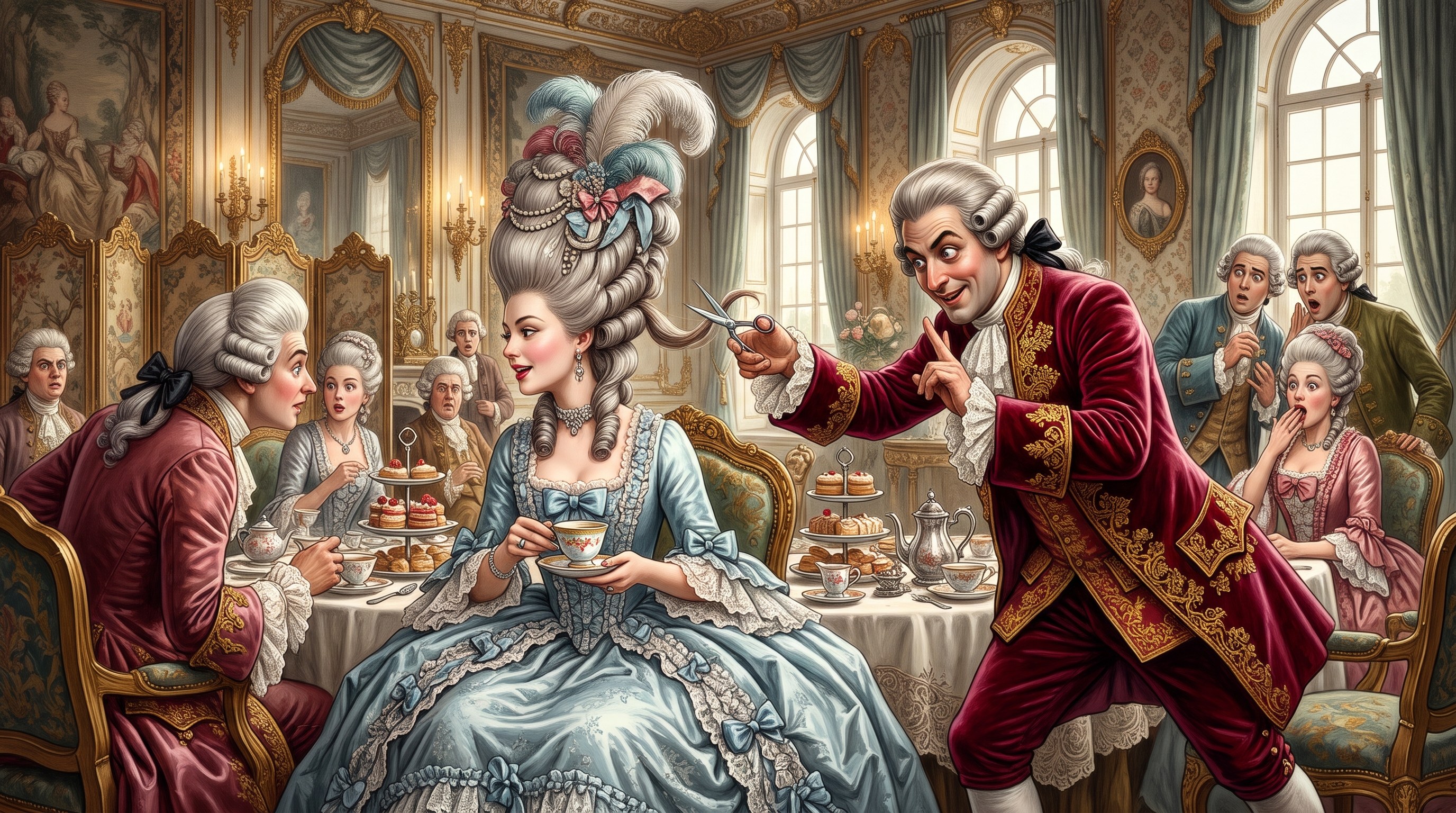
The Neoclassical Period (1660–1798): The Age of Reason and Satire
If the Renaissance was the age of passionate, overflowing emotion and grand tragedy, the Neoclassical period was the exact opposite. It was the age of logic, order, and strict rules.
After decades of bloody civil war and the strict, joyless rule of the Puritans, the English people were exhausted. They wanted stability. They wanted reason. They wanted a world that made sense.
The word "Neoclassical" literally means "New Classical." Writers of this era looked back at the ancient Roman and Greek writers (like Homer and Virgil) and decided that those old classics had perfected the art of writing. Therefore, modern writers believed they should imitate the ancients. They believed writing should follow strict rules, be highly structured, and appeal to the head rather than the heart.
Here is everything you need to know about the Neoclassical Period.
Part 1: The Historical Context (A New World Order)
To understand the literature of this era, you must understand how drastically English society changed between 1660 and 1798. It was a time of political earthquakes, the rise of the middle class, and a radical shift in how people viewed the universe.
1. The Restoration of the Monarchy (1660)
The era begins in 1660 with the Restoration. After the Puritans (led by Oliver Cromwell) banned the theatre, closed the pubs, and enforced strict religious rules, the people had enough. When Cromwell died, the English invited King Charles II to return from exile in France and take the throne.
- The Vibe Shift: Charles II had spent years in the French court. He brought back a love of pleasure, fashion, wit, and sexual freedom. People were tired of being told how to live by strict priests. They wanted to have fun.
- The Reopening of Theatres: One of Charles II's first acts was to reopen the theatres. For the first time in English history, women were officially allowed to act on stage (previously, all female roles were played by young boys).
2. The Glorious Revolution (1688)
In 1688, King James II (a Catholic) was overthrown by Parliament in favor of William and Mary (Protestants). This was a massive turning point. It proved that the King could not rule without the permission of Parliament. England became a Constitutional Monarchy. Power shifted away from the king and into the hands of the wealthy middle class.
3. The Rise of the Middle Class and Coffeehouses
Because of the new political stability and expanding global trade, the middle class (merchants, bankers, lawyers) grew incredibly wealthy and powerful.
- The Coffeehouse Culture: Coffee was a new import. Coffeehouses opened all over London. For the price of a penny, a man could sit in a coffeehouse, drink coffee, read the newspaper, and argue about politics, science, and literature. It became the hub of intellectual life.
4. The Age of Enlightenment and Science
This was the era of Sir Isaac Newton (who discovered gravity) and the scientific revolution. People began to believe that the universe was a giant machine governed by logical laws. Writers believed that human society could also be perfected through logic, education, and reason.
Part 2: The Neoclassical Mindset (The Rules of Writing)
Neoclassical writers believed that the Renaissance had let emotions get out of control. They wanted to restore order. If you are analyzing a Neoclassical text, look for these core beliefs:
1. The Supreme Importance of Reason
Emotion was considered dangerous. A good writer appealed to the brain, not the heart. Literature was supposed to "instruct and delight"—meaning it had to teach a moral lesson while also being entertaining. The goal was not to make you cry; the goal was to make you think.
2. Imitation of the Ancients
Writers believed that the ancient Romans and Greeks had already discovered the perfect rules of writing. They studied classical epics, odes, and satires and tried to imitate their style. They believed in Decorum—the idea that a king should speak like a king, and a peasant should speak like a peasant. A tragedy must have a sad ending, and a comedy must have a happy one.
3. The Heroic Couplet
This was the dominant poetic form of the age. It is a pair of rhyming lines written in iambic pentameter (10 syllables per line).
"True ease in writing comes from art, not chance,
As those move easiest who have learned to dance."
(Alexander Pope)
The Heroic Couplet is perfectly logical—it states an idea in the first line and then completes it with a punchy rhyme in the second. It is neat, tidy, and mathematical.
4. The Power of Satire
Since the middle class was rising and society was changing, writers used Satire (the use of humor, irony, and exaggeration to expose and criticize people's stupidity or vices) to mock society. They didn't write sad poems about lost love; they wrote funny, sharp poems making fun of corrupt politicians, fake scientists, and vain socialites. Satire was a weapon used to correct the flaws of society.
Part 3: The Restoration Age (1660–1700)
The first phase of the Neoclassical period is named after the return of the King. The literature of this era was highly cynical, witty, and sexually explicit.
1. John Dryden (1631–1700)
He was the dominant literary figure of the Restoration. He was the first official Poet Laureate of England. He wrote brilliant satirical poems (like Absalom and Achitophel) and perfectly structured plays. He was the master of the Heroic Couplet and set the standard for the era.
2. The Comedy of Manners
This was the most popular form of drama during the Restoration. These were highly sophisticated, witty, and cynical plays that made fun of the upper class.
- The Plot: They usually involved scandal, gossip, and sexual affairs among the rich.
- The Style: Characters spoke in brilliant, sharp, insulting dialogue. It was all about "wit"—the ability to say clever, biting things.
- Famous Writers: William Congreve (The Way of the World) and George Etherege.
3. Aphra Behn (1640–1689)
A groundbreaking figure. She was a spy for King Charles II and a writer. She became one of the first English women to earn a living solely through writing. She wrote brilliant plays, but her most famous work is Oroonoko, a novel about an African prince who is kidnapped and sold into slavery. It is one of the earliest English novels and a powerful anti-slavery text.
Part 4: The Augustan Age (1700–1745)
This period is named after the Roman Emperor Augustus, because English writers believed their era was the modern equivalent of a golden age of peace and art. This was the absolute peak of English satire.
1. Alexander Pope (1688–1744)
The greatest poet of the 18th century. Pope was a hunchback and suffered from severe health issues, but his mind was razor-sharp. He was a master of the Heroic Couplet.
- His Masterpiece: The Rape of the Lock. A mock-epic poem. A "mock-epic" takes a silly, trivial event and describes it using the grand, serious language of an ancient epic. The poem is about a rich young woman whose lover steals a lock of her hair. Pope describes this event with gods, battles, and heroic speeches, making the rich upper class look completely ridiculous.
- His Philosophy: An Essay on Man. A profound poem about humanity's place in the universe.
2. Jonathan Swift (1667–1745)
The greatest prose satirist in the English language. Swift was deeply cynical about human nature. He was an Irish priest who hated the English government’s mistreatment of the Irish people.
- His Masterpiece: Gulliver's Travels. Most people think this is a children's book about a man who goes to a land of tiny people. It is actually a dark, bitter satire mocking human politics, scientists, and our deepest flaws.
- The Ultimate Satire: A Modest Proposal. A pamphlet where Swift suggests that the starving Irish people should sell their babies as food to the rich English landlords. He wasn't serious, of course; he used extreme sarcasm to show how the English were literally eating the Irish alive.
3. Joseph Addison and Richard Steele
These two men changed journalism forever with their daily newspaper, The Spectator. Instead of writing about politics, they wrote about everyday life: manners, fashion, morality, and polite behavior. They aimed to educate the newly rich middle class and help them become "refined" ladies and gentlemen.
Part 5: The Age of Sensibility and the Rise of the Novel (1745–1798)
In the later part of the century, the mood began to shift. People started to get a little tired of pure logic and satire. They wanted to feel emotion again. This shift is called the Age of Sensibility (or the Age of Johnson, named after Dr. Samuel Johnson, who wrote the first comprehensive Dictionary of the English Language in 1755).
1. The Birth of the Modern Novel
This is one of the most important developments in literary history. During this era, the modern novel was born.
- Why now? The middle class had more money and more free time. The printing press was cheaper. And readers wanted to read stories about regular people in real-life situations (not kings and gods).
- Daniel Defoe: Wrote Robinson Crusoe (1719), often called the first English novel. It is the story of a shipwrecked man surviving alone on an island for 28 years.
- Samuel Richardson: Wrote Pamela (1740). A massive bestseller written entirely in the form of letters (an epistolary novel). It was about a poor, virtuous servant girl who fights off the advances of her rich master and eventually marries him.
- Henry Fielding: Wrote Tom Jones to mock Richardson's Pamela. It is a hilarious, sprawling story about a foundling (an abandoned child) who has many wild adventures.
2. The Graveyard Poets
As the era ended, writers started focusing on death, melancholy, and nature. Thomas Gray wrote Elegy Written in a Country Churchyard, a deeply sad and beautiful poem that reflects on the lives of poor, uneducated people who die unknown:
"Full many a flower is born to blush unseen,
And waste its sweetness on the desert air."
Part 6: The End of the Era (1798)
The Neoclassical period officially ends in 1798 with the publication of Lyrical Ballads by William Wordsworth and Samuel Taylor Coleridge.
But the political spark that ended the era was the French Revolution (1789). The French people overthrew their king and demanded freedom and equality. English writers were divided. The older generation was horrified by the violence, while the younger generation was inspired by the dream of freedom.
The age of logic, reason, and strict rules was over. The age of revolution, intense emotion, and the worship of nature was about to begin.
Quick Summary: Exam Cheat Sheet
- Time Period: 1660 (Restoration) – 1798 (Lyrical Ballads).
- Historical Context: The return of the King, the rise of the middle class, coffeehouses, the Scientific Revolution, and the French Revolution.
- Key Philosophies: Logic, reason, order, and strict adherence to classical rules. Literature must "instruct and delight."
- Major Poetic Form: The Heroic Couplet (rhyming pairs of 10-syllable lines).
- The Big Writers: Alexander Pope: Master of the mock-epic (The Rape of the Lock). Jonathan Swift: Master of prose satire (Gulliver's Travels, A Modest Proposal). John Dryden: The first master of the era.
- Major Forms: Satire, Comedy of Manners (Restoration Drama), and the Birth of the Novel (Robinson Crusoe).
- Women Writers: Aphra Behn (the first professional female writer) and the rise of the female reader.
- The End: The French Revolution and the publication of Lyrical Ballads (1798) mark the start of the Romantic era.