
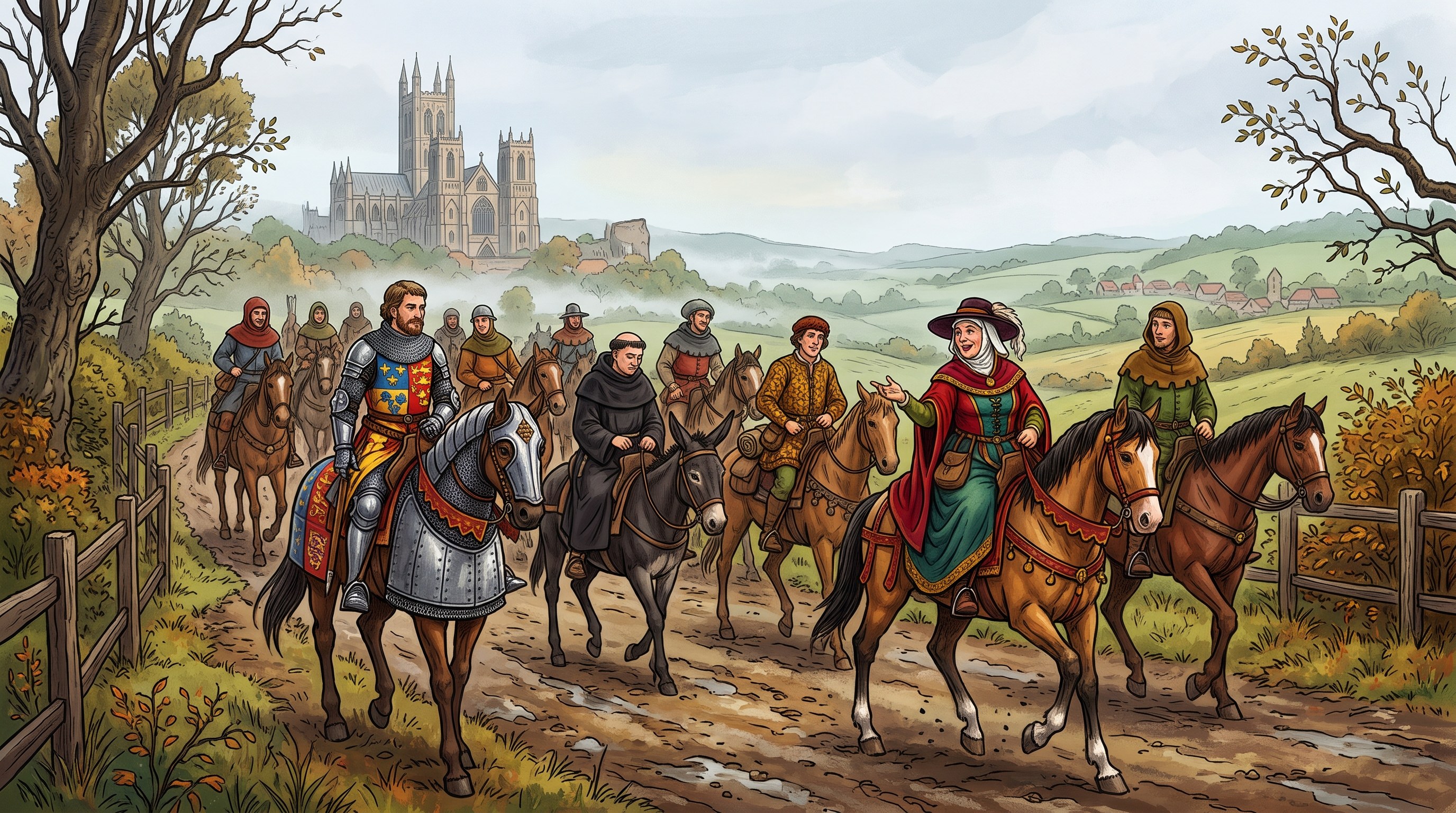
The Middle English Period (1066–1500): The Rebirth of English Literature
Imagine waking up one day to find that the rulers of your country speak a completely different language. You are not allowed to use your native tongue in court, in business, or in school. If you want to get a good job or gain any power, you must learn the language of the invaders.
This is exactly what happened to the English people in the year 1066.
The Middle English period is one of the most fascinating and chaotic eras in literary history. It is the story of how the English language nearly died, went underground for 300 years, and then re-emerged as a completely new, hybrid language. It is the bridge between the brutal, heroic world of the Anglo-Saxons and the brilliant, theatrical world of Shakespeare.
Here is everything you need to know about the Middle English Period.
Part 1: The Historical Tapestry
To understand the literature of this era, you must understand the massive social and political earthquakes that shook England.
The Norman Conquest (1066)
The Middle English period begins abruptly with the Norman Conquest. William the Conqueror, the Duke of Normandy (a region in France), crossed the English Channel and defeated the Anglo-Saxon King Harold at the Battle of Hastings.
William took total control of England. He replaced the entire English nobility with French-speaking Normans. He built castles to intimidate the locals and commissioned the Domesday Book to tax every piece of land in the country.
The Feudal System and the Three Languages
The Norman conquest created a rigid, three-tiered society, and language became a symbol of class:
- The Clergy (The Church): Spoke Latin. They controlled education and kept all religious records.
- The Nobility and Court (The Rulers): Spoke Anglo-Norman French. This was the language of power, law, and fashion.
- The Peasants (The Common People): Spoke Old English. This was the language of the farm, the kitchen, and the street.
For nearly 300 years, English was considered a "vulgar" or low-class language. A famous historical anecdote says that when the French-speaking nobles ate the cooked meat, they called it beef (from the French boeuf), but when the English-speaking peasants looked after the animal in the field, they called it a cow.
The Black Death (1348)
The 14th century was a nightmare. The Bubonic Plague (The Black Death) swept through Europe, killing nearly one-third of England’s population. Entire villages were wiped out.
Because so many peasants died, the survivors suddenly found their labor was highly valuable. For the first time, a peasant could demand higher wages. This led to the rise of a middle class (merchants, artisans, and traders) and a massive shift in social power away from the old nobility.
The Peasants' Revolt (1381)
Tired of heavy taxes and unfair laws, the common people finally snapped. Thousands of peasants marched on London, led by a man named Wat Tyler. They demanded better rights and the end of the feudal system. The rebellion was crushed, but it terrified the ruling class. Literature began to reflect this new reality: ordinary people were becoming important.
Part 2: The Evolution of the Language
Old English (like Beowulf) is basically a foreign language to us. Middle English (like The Canterbury Tales) looks strange, but we can usually figure out what it means.
Why did the language change so drastically?
Because the French and English people started intermarrying and trading, the languages blended.
- Lost Endings: Old English had complex, German-like endings for words (called inflections) to show grammatical cases. Because French speakers couldn't remember these, the endings were dropped.
- Word Order: Since the endings were gone, English had to rely strictly on word order (Subject-Verb-Object) to make sense.
- The Vocabulary Explosion: Over 10,000 French words entered the English language during this period. English speakers also started using Latin words for science and philosophy.
By the late 1300s, English was finally allowed back into the law courts and schools, but it was a highly mixed language. It was the language of the streets, but now it had the sophistication of the French and Latin vocabularies.
Part 3: The Masterpiece – The Canterbury Tales
The undisputed giant of the Middle English period is Geoffrey Chaucer. He is often called the "Father of English Literature."
Chaucer was a diplomat, a soldier, and a government official. Because of his job, he traveled to France and Italy, reading the great writers of Europe. But he made a radical decision: instead of writing in French or Latin, he wrote in Middle English.
The Story of The Canterbury Tales
The poem is a frame narrative. It is a story about people telling stories.
Thirty pilgrims (including a knight, a miller, a nun, a merchant, and a doctor) gather at the Tabard Inn in London. They are going on a pilgrimage to Canterbury to visit the shrine of Saint Thomas Becket to pray for good health. The host of the inn suggests a contest: to pass the time, each pilgrim must tell two stories on the way there, and two on the way back. The winner gets a free meal.
The Genius of Chaucer
Chaucer was a master of Estate Satire—making fun of the different social classes of his time. He created a perfect cross-section of 14th-century society:
- The Knight: An ideal, honorable warrior who has fought in the Crusades.
- The Parson: The ideal priest—poor, honest, and dedicated to his village.
- The Pardoner: A deeply corrupt church official who sells fake religious relics to poor people.
- The Wife of Bath: A bold, confident, five-times-married woman who argues that women should rule the marriage. She is one of the first complex, fully developed female characters in English literature.
Why it matters: Chaucer used irony and humour. He pretends to praise the corrupt characters while secretly exposing their greed. He humanized literature by writing about everyday life.
Part 4: The Other Major Works (Beyond Chaucer)
While Chaucer is the brightest star, the Middle English period produced several other incredible works.
1. Sir Gawain and the Green Knight (The Pearl Poet)
This is a famous Arthurian romance written in alliterative verse (bringing back the Old English style).
The Plot: On New Year's Eve, a massive, entirely green knight rides into King Arthur's court. He challenges anyone to strike him with his axe, on the condition that the knight can return the blow in one year. Sir Gawain, Arthur's most honorable knight, accepts. He chops off the Green Knight's head—but the knight simply picks up his head, reminds Gawain of the promise, and rides away.
The Theme: It explores the conflict between chivalry (honor, bravery, and purity) and human nature (the fear of death and the temptation of survival).
2. Piers Plowman (William Langland)
This is a long, angry, religious allegorical poem. It is highly critical of the corruption in the Church (rich bishops, lazy monks). It tells the story of a simple farmer named Piers who falls asleep on a hill and has a series of visions. It was hugely popular among the common people and was even used as a rallying cry during the Peasants' Revolt.
3. Le Morte d'Arthur (Sir Thomas Malory)
Written at the very end of the Middle English period (around 1470), this is the definitive collection of the King Arthur legends. Written in prose, it tells the story of Arthur, Guinevere, Lancelot, and the Knights of the Round Table. It is a sad story about how a perfect kingdom falls apart because of human betrayal.
4. The Book of Margery Kempe
This is arguably the first autobiography written in the English language. Margery Kempe was a middle-class woman who had visions of Christ. She dictated her life story to a scribe. It is a fascinating look at the life of a medieval woman, her travels, her struggles with her husband, and her extreme religious devotion.
Part 5: The Dawn of English Drama
Before the Middle Ages, there was no real English theater. Literature was read aloud or sung. But the Church realized that most people couldn't read, so they started acting out Bible stories inside the churches to teach the congregation. This gave birth to two types of plays:
- Mystery Plays: These were short plays performed by the town guilds (like the bakers or the carpenters) that re-enacted Bible stories (such as Noah's Ark, or the Crucifixion of Christ). They were often funny, highly relatable, and sometimes featured angry wives arguing with Noah.
- Morality Plays: These plays featured characters that represented abstract concepts. The characters were literally named "Good Deeds," "Knowledge," "Greed," and "Death." The most famous is Everyman, which is about God sending Death to summon a man (Everyman) to account for his life. When Everyman tries to bring his friends (Fellowship, Goods), they all abandon him. Only Good Deeds goes with him to the grave.
Part 6: The End of the Era (The Game Changer)
The Middle English period comes to an end around 1500, and it is largely due to one incredible invention: The Printing Press.
In 1476, William Caxton brought the printing press to England. Before this, books were hand-copied by monks, taking months to make and costing a fortune.
Caxton's press changed everything:
- Books became cheap and fast to produce.
- Standardization: Because England had so many different regional dialects, Caxton chose the London dialect (the language of Chaucer and the government) as the standard. This is why we spell words the way we do today.
- It paved the way for the Renaissance.
Quick Summary: Exam Cheat Sheet
If you need to remember the Middle English period for an exam, memorize these core points:
- Time Period: 1066 (Norman Conquest) – 1500 (Renaissance/Printing Press).
- Language: Old English mixed with French and Latin (resulting in a massive vocabulary).
- Key Historical Events: Norman Conquest, The Black Death, Peasants' Revolt.
- The Big Writer: Geoffrey Chaucer (The Canterbury Tales).
- Major Themes: Religion, chivalry, corruption of the church, social class, and the rise of the common man.
- Literary Forms: Frame narratives, Arthurian romances, Allegories (Piers Plowman), and early Drama (Mystery and Morality plays).
- The End: William Caxton introduces the printing press, standardizing English and ending the manuscript era