
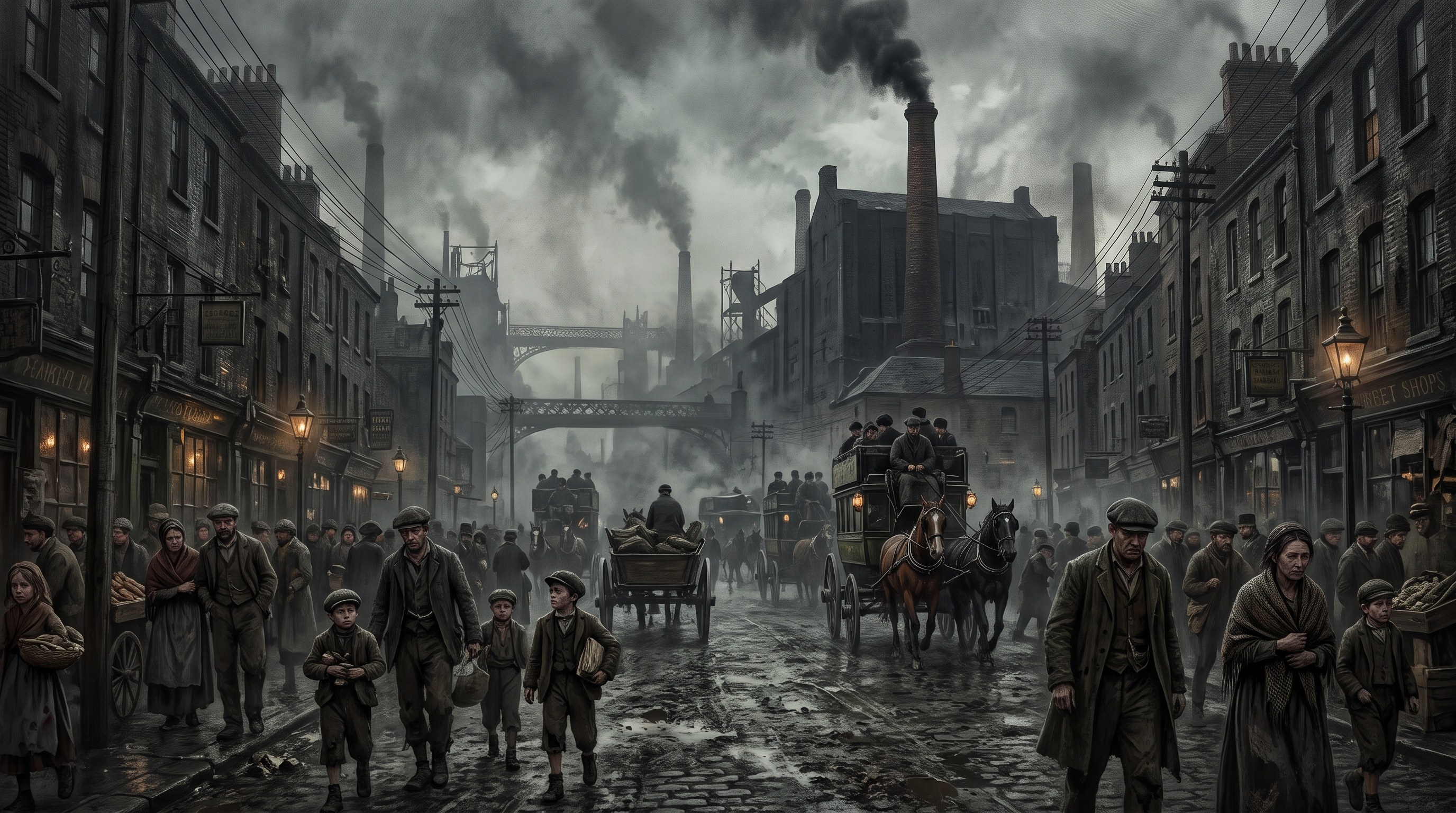
The Victorian Period (1837–1901): The Age of Empire and Anxiety
When Queen Victoria took the throne in 1837, England was the most powerful nation on earth. The British Empire covered a quarter of the globe, and the sun literally never set on it. The country was buzzing with the wealth and progress of the Industrial Revolution.
But behind the closed doors of polite society, the Victorians were deeply anxious.
The Victorian era is an age of massive contradictions. On the outside, it was an era of strict morality, family values, and outward respectability. But underneath, it was an era of crushing poverty, child labor, hypocrisy, and a terrifying loss of religious faith.
Writers of this era were not just dreamers; they were social critics, moral guides, and the conscience of the nation.
Here is everything you need to know about the Victorian Period.
Part 1: The Historical Context (The Empire and the Machine)
To understand Victorian literature, you must understand the world that created it. It was an era of incredible progress and terrible suffering.
1. The Height of the British Empire
By the 1850s, Britain was the undisputed global superpower. It had the strongest navy, the largest economy, and colonies all over Africa and Asia (including the Indian subcontinent). This wealth poured into London, creating a massive, wealthy middle class. However, the Victorians used this power to justify imperialism, often believing they were "civilizing" the rest of the world.
2. The Industrial Revolution (Fully Established)
The factories that began in the Romantic era now dominated the landscape. Railways connected the whole country, and steam power changed everything.
- The Dark Side: While the rich got richer, the working class suffered terribly. Cities were choked with smog. Men, women, and children worked 16-hour days in coal mines and textile mills for pennies.
3. The Crisis of Faith (Science vs. Religion)
This is the most important philosophical event of the era. In 1859, Charles Darwin published On the Origin of Species. His theory of evolution by natural selection directly challenged the biblical story of creation.
- The Result: This caused a massive crisis of faith. If humans were just evolved animals, where did the soul come from? Did God even exist? Many writers struggled with doubt, fear, and a sense of profound loss.
4. Victorian Morality (The Great Hypocrisy)
The Victorians were obsessed with "respectability." They were prudish about sex, strict about manners, and obsessed with outward appearances. The ideal woman was the "Angel in the House"—pure, submissive, and devoted only to her husband and children.
- The Hypocrisy: The same society that praised sexual purity had thousands of prostitutes on the streets of London. The same society that praised family values sent young children to work in factories. Literature of this era constantly points out this hypocrisy.
Part 2: The Victorian Mindset (The Core Themes)
Victorian writers focused on the problems of society. They believed that literature had a moral duty to expose the truth.
1. Utilitarianism vs. Humanism
Utilitarianism was the dominant philosophy of the time: the idea that an action is only good if it is useful (e.g., making money, building factories). Victorian writers hated this. They argued that art, beauty, and human kindness were more important than profit.
2. Social Reform
Because of the extreme poverty, writers became deeply involved in social reform. They wrote about the poor, the orphans, the abused children, and the struggling workers. They believed literature could change the law.
3. The "Woman Question"
The Victorian era saw the first major wave of feminism. Women were trapped by strict laws and social expectations. Writers began to question why women couldn't go to university, own property, or vote.
4. The Spirit of Doubt
Unlike the Romantics, who were sure of their feelings, Victorian writers were full of doubt. They questioned God, morality, and the future of humanity.
Part 3: The Golden Age of the Novel
The Victorian era is considered the Golden Age of the Novel. Novels were incredibly popular because they were published in monthly magazines (serial fiction). People would wait eagerly for the next chapter of a Dickens novel, just like we wait for the next episode of a TV show today.
1. Charles Dickens (1812–1870)
The greatest novelist of the Victorian era. Dickens himself grew up in poverty; his father was thrown into a debtors' prison, and young Charles was forced to work in a blacking factory at age 12. This trauma fueled his writing for the rest of his life.
- His Style: He wrote massive, sprawling novels that exposed the social evils of his time: the poor laws, the brutal schools, the corrupt legal system, and the exploitation of children. He was also hilariously funny and created some of the most famous characters in literature.
- Famous Works: Oliver Twist (about a poor orphan trapped in the criminal underworld), A Christmas Carol (about the greedy Scrooge and the true meaning of charity), Great Expectations, and Bleak House.
2. The Brontë Sisters (Charlotte, Emily, and Anne)
The Brontë sisters grew up isolated on the wild Yorkshire moors. They wrote some of the most passionate and rebellious novels of the era.
- Charlotte Brontë: Wrote Jane Eyre. It is the story of a plain, poor, but fiercely independent governess who falls in love with the dark, mysterious Mr. Rochester.
- Emily Brontë: Wrote Wuthering Heights. A wild, violent novel about the destructive love between Heathcliff and Catherine. It is full of the Romantic love for nature and the sublime.
3. George Eliot (Mary Ann Evans, 1819–1880)
She used a male pen name because women writers were often dismissed. Eliot was a brilliant philosopher. Her novels focus on the psychology of ordinary people in quiet country towns.
- Her Masterpiece: Middlemarch. It is often called the greatest novel in the English language. It explores the lives, marriages, and ambitions of people in a small town, showing the deep tragedy of unfulfilled dreams.
4. Thomas Hardy (1840–1928)
Hardy's novels are dark, tragic, and deeply pessimistic. He believed that humans are just playthings of fate. He set his novels in "Wessex" (a fictional version of his home county of Dorset).
- Famous Works: Tess of the d'Urbervilles (a tragic story of a pure woman ruined by society's double standards), and Jude the Obscure (so controversial for its criticism of marriage that it was publicly burned).
5. William Makepeace Thackeray (1811–1863)
Thackeray was the ultimate satirist. He saw the Victorian obsession with money and social climbing and ruthlessly mocked it.
- His Masterpiece: Vanity Fair. A brilliant, witty novel about two women—one good, one bad—who climb the social ladder in a society obsessed with wealth.
Part 4: The Victorian Poets
Poetry in the Victorian era moved away from the wild imagination of the Romantics and focused on doubt, science, and social responsibility.
1. Alfred, Lord Tennyson (1809–1892)
He was the official Poet Laureate and the voice of the Victorian era. His poetry perfectly captures the conflict between faith and science.
- Famous Works: In Memoriam A.H.H. (a long, moving poem about the death of his best friend, which expresses the deep doubt caused by science), and The Charge of the Light Brigade (a heroic, rhythmic poem about a disastrous military blunder).
2. Robert Browning (1812–1889)
Browning is famous for inventing the Dramatic Monologue—a poem where a character speaks to a silent listener, revealing their deepest (and often darkest) secrets.
- Famous Work: My Last Duchess. A chilling poem where a Duke reveals he had his previous wife murdered because she smiled too much.
3. Elizabeth Barrett Browning (1806–1861)
She was one of the most respected poets of the era. She suffered from illness and was kept in isolation by her father. She wrote passionate poetry about love and social injustice.
- Famous Work: Sonnets from the Portuguese (a collection of love poems written for her husband, Robert Browning).
4. Matthew Arnold (1822–1888)
Arnold was a cultural critic and a poet of deep melancholy. He deeply felt the loss of faith in the Victorian era.
- Famous Work: Dover Beach. A poem describing the sound of the waves on the beach, which is compared to the "melancholy, long, withdrawing roar" of religious faith leaving the world.
Part 5: The Late Victorians and Drama
As the century neared its end, the strict Victorian rules began to crumble. A new generation of writers rejected the hypocrisy of their elders.
1. Oscar Wilde (1854–1900)
Wilde was a brilliant, flamboyant Irish writer. He believed in Aestheticism—the idea of "Art for Art's sake." He believed that art should be beautiful and exciting, and it should not be a boring moral lesson.
- His Style: He was the master of wit and epigrams (short, clever sayings). He mocked the Victorian upper class mercilessly.
- His Masterpiece: The Importance of Being Earnest (a brilliant, hilarious play mocking Victorian manners and marriage).
- The Tragic End: Wilde was sentenced to two years of hard labor for homosexuality (which was illegal at the time). He died in poverty in Paris.
2. George Bernard Shaw (1856–1950)
Shaw was a playwright who used the theatre to debate social issues (socialism, women's rights, poverty). He believed that plays should make the audience uncomfortable and think about changing the world.
- Famous Work: Pygmalion (the play that later became the musical My Fair Lady), which explores class and language.
Part 6: The End of the Era (1901)
The Victorian period officially ends in 1901 with the death of Queen Victoria.
But the true end came with the devastating shock of World War I (1914–1918). The Victorians had believed in progress, empire, and the glory of war. World War I destroyed all of that. Millions of young men were slaughtered in the trenches of Europe.
The optimism of the Victorian age was shattered forever. The world was left broken and disillusioned. It was time for a completely new way of writing. The Modernist era was about to begin.
Quick Summary: Exam Cheat Sheet
- Time Period: 1837 – 1901.
- Historical Context: The British Empire, the Industrial Revolution, Darwin's Theory of Evolution (the crisis of faith), and strict social morality.
- Key Philosophies: Social reform, the conflict between science and religion, criticism of hypocrisy, and utilitarianism vs. humanism.
- The Big Writers (Novelists): Charles Dickens (Oliver Twist), George Eliot (Middlemarch), Emily Brontë (Wuthering Heights), Thomas Hardy (Tess of the d'Urbervilles).
- The Big Writers (Poets): Alfred Lord Tennyson (In Memoriam), Robert Browning (My Last Duchess), Matthew Arnold (Dover Beach).
- The Big Writers (Playwrights): Oscar Wilde (The Importance of Being Earnest).
- Major Forms: The Serial Novel (the golden age of the novel), the Dramatic Monologue, and the Problem Play.
- The End: Queen Victoria's death, the beginning of modernism, and the shadow of World War I