
The Old English Period (450–1066): The Birth of English Literature
If you were to travel back in time to England in the year 800 and step into a crowded wooden hall, you would not understand a single word being spoken. The language would sound harsh, guttural, and much closer to modern German than the English we speak today.
This is the world of Old English (also known as Anglo-Saxon) literature.
It was a time of harsh winters, invading armies, and fierce loyalty. There were no printing presses or public libraries. Most people could not read or write. Instead, literature was an experience—it was spoken out loud, chanted in great halls, and accompanied by the strumming of a harp. It was a literature born from the clash of pagan warrior culture and the newly arrived Christian faith.
Here is everything you need to know about the oldest and most foundational age of English Literature.
Part 1: The Historical Context – Who Were the Anglo-Saxons?
To understand the literature, you must first understand the people who created it.
Before the Anglo-Saxons arrived, Britain was a Roman colony. But when the Roman Empire collapsed around 410 AD, the Romans packed up and left, leaving the native Britons (the Celts) vulnerable to attack.
Soon, three Germanic tribes from northern Europe—the Angles, Saxons, and Jutes—began invading and settling in Britain. They pushed the native Celts into the mountains of Wales, Scotland, and Cornwall. The word "England" actually comes from the Angles—it means "Land of the Angles."
The Seven Kingdoms (The Heptarchy)
The Anglo-Saxons did not form one unified country immediately. Instead, they established several small, constantly warring kingdoms. This period is known as the Heptarchy (rule of seven). The most famous kingdoms were Wessex, Mercia, Northumbria, and East Anglia.
The Viking Threat
In the late 8th century (starting in 793 AD with the attack on Lindisfarne), the Vikings from Scandinavia began raiding and invading England. They were brutal, fierce, and destroyed many monasteries (which were the centers of learning). Eventually, the Anglo-Saxon king Alfred the Great (of Wessex) managed to stop them and forced them to settle in a specific area called the Danelaw.
The Arrival of Christianity
In 597 AD, a monk named St. Augustine arrived in England to convert the Anglo-Saxons to Christianity. This was a turning point. The monks brought Latin, literacy, and books. They began writing down the oral stories that the Anglo-Saxons had been telling for centuries.
The Conflict: Because the monks were Christian and the original stories were Pagan, the literature often shows a fascinating clash of beliefs. You will read about a warrior who believes in "wyrd" (fate), but the monk who wrote the story down adds a Christian blessing to it.
Part 2: Life and Society in the Anglo-Saxon Era
Old English literature is a direct mirror of Anglo-Saxon society. It was a masculine, violent, and heavily structured world.
1. The Comitatus Code (The Bond of Loyalty)
This is the most important concept in Old English literature. The comitatus was a deep bond of loyalty between a king (the lord) and his warriors (the thanes).
- The king provided his warriors with gold, swords, armor, and land.
- In return, the warriors swore absolute loyalty. They had to fight to the death for their king. If the king died in battle, his warriors were expected to avenge him or die beside him. Living after your king was killed was considered the ultimate shame.
2. The Mead Hall
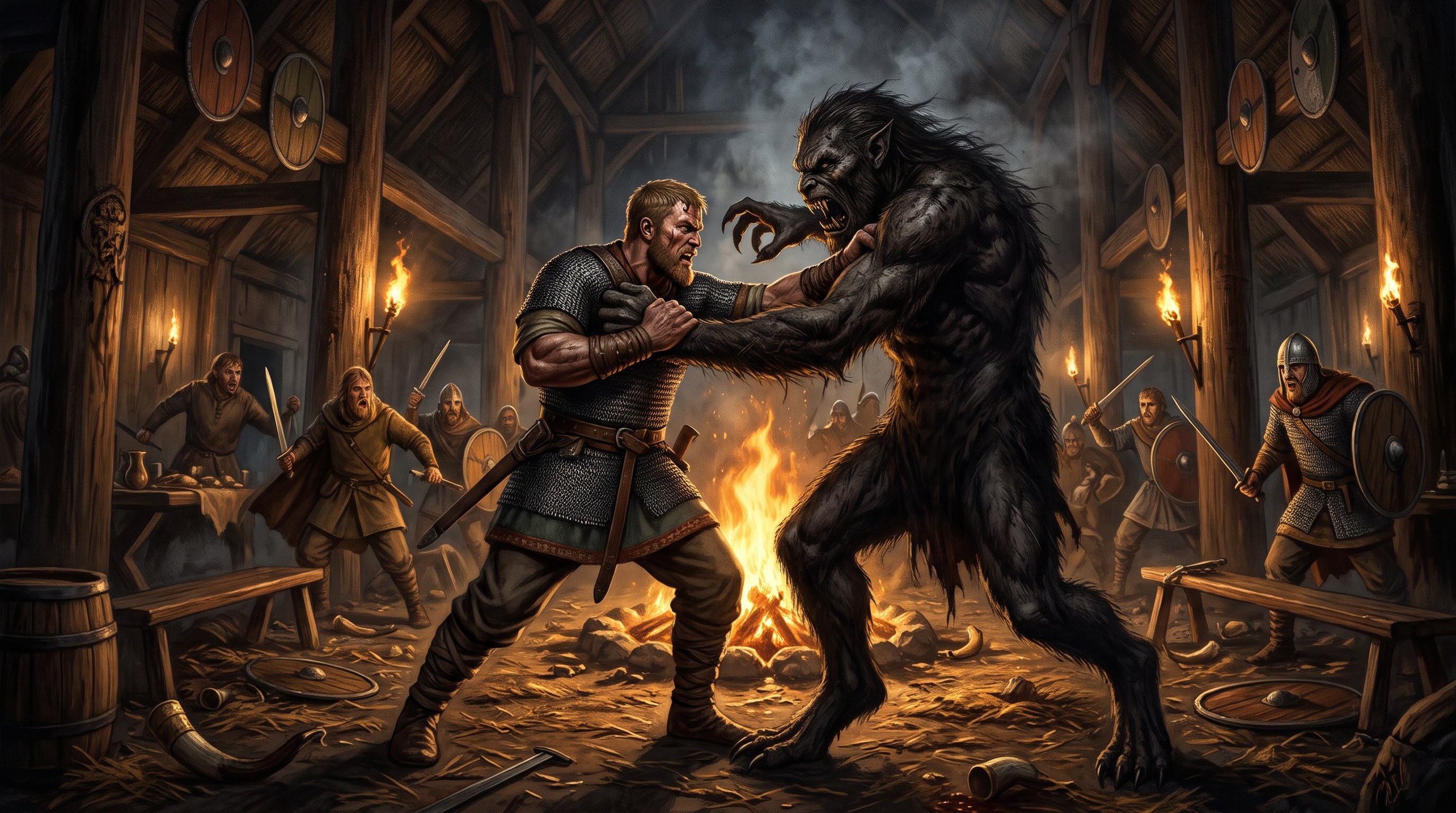
The center of the Anglo-Saxon world was the Mead Hall (a large wooden building like Heorot in Beowulf). It was not just a place to sleep; it was the center of civilization. Inside the hall, warriors drank mead (a honey-based alcohol), feasted, received gifts from the king, and listened to poetry. Outside the hall lay the "dark, cold world" of monsters, wild animals, and enemy attacks.
3. The Scop
The Scop was the official poet of the tribe. He was highly respected, often traveling with the king. The Scop played a harp and recited long, heroic poems from memory. He was the historian and the entertainer of his time.
Part 3: The Rules of Old English Poetry
Old English poetry did not use rhyme like modern poetry. Instead, it followed strict, almost mathematical rules of sound and rhythm.
1. Alliteration
This is the backbone of Old English poetry. Instead of rhyming the ends of lines, the poet repeated the first consonant sound of words within the same line.
- Example: "The mighty monster moved through the mist."
2. The Caesura
Every line of Old English poetry was divided into two halves by a dramatic pause in the middle. This pause is called a caesura. It gave the scop time to breathe and created a heavy, rhythmic beat.
- Example: "The hero stood firm || and faced the dragon."
3. Kennings
A kenning is a poetic metaphor, almost like a riddle, used to describe a simple object in a highly creative, compressed way. It is one of the most beautiful features of the language.
- Instead of saying sea, they said "whale-road" or "swan-road".
- Instead of saying blood, they said "battle-sweat" or "battle-icicles".
- Instead of saying king, they said "ring-giver" (because a king distributed rings of gold).
- Instead of saying body, they said "bone-house".
4. The Elegiac Tone (Gloom and Doom)
Because life was so short and war was always present, Old English literature is famously dark. Even the heroic poems have a sad undertone. The Anglo-Saxon understood that everything in life eventually fades away.
Part 4: The Masterpiece - Beowulf
The crown jewel of Old English literature is Beowulf. It is the oldest surviving long poem in the English language (over 3,000 lines long), likely composed around 700 AD but written down around 1000 AD.
It is a classic epic poem.
The Story:
- Part 1 (Grendel): A monster named Grendel has been terrorizing King Hrothgar’s Mead Hall (Heorot) for twelve years because he hates the sound of happiness. Beowulf, a warrior from Geatland (modern-day Sweden), arrives with his men. He boasts of his strength, waits for Grendel, and rips the monster's arm off with his bare hands. Grendel flees and dies.
- Part 2 (Grendel's Mother): Grendel's mother attacks the hall in revenge, killing Hrothgar's closest friend. Beowulf tracks her to her underwater lair, kills her with a magical sword, and returns to the surface.
- Part 3 (The Dragon): Beowulf returns home, becomes King of the Geats, and rules well for fifty years. Eventually, a dragon attacks his people because a thief stole its treasure. Beowulf, now an old man, goes to fight the dragon. With the help of a young warrior named Wiglaf, he kills the dragon but is mortally wounded. The poem ends with his funeral.
Key Themes in Beowulf:
- The Heroic Ideal: Beowulf is the perfect warrior—strong, loyal, brave, and polite.
- Pagan vs. Christian: The characters are pagan warriors, but the narrator (the monk) calls Grendel a descendant of Cain (from the Bible) and thanks God for Beowulf's victories.
- Fate (Wyrd): The warriors believe that destiny is unavoidable. Beowulf says, "Fate always goes as it must."
Part 5: Other Major Works of the Era
While Beowulf is the most famous, there are several other crucial texts you must know.
The Elegies (Sad Poems of Exile)
1. The Wanderer
This poem is about an old warrior who has lost his king and his comrades. He is now a lonely exile, sailing the freezing winter seas. He dreams of the warm Mead Hall and the joy of his past life, but wakes up to the harsh reality of the ocean. It is a perfect example of the Anglo-Saxon fear of loneliness and the loss of the comitatus bond.
2. The Seafarer
Similar to The Wanderer, this poem talks about the brutal, freezing life of a sailor on the ocean. However, it transitions from a physical journey to a spiritual one, expressing the idea that the world is temporary and true home is in heaven.
3. The Wife's Lament
This is a rare exception: a poem told from the perspective of a woman. She is exiled to a cave in a forest by her husband (likely because of a political feud) and spends her days mourning her lost love and the cruelty of her exile.
The Heroic Poems
1. The Battle of Maldon
This poem tells the story of a real historical battle in 991 AD against Viking invaders. It captures the comitatus code perfectly. In the poem, an old warrior named Byrhtwold delivers one of the most famous speeches in Old English literature:
"Mind must be the firmer, heart the more fierce, courage the greater, as our strength diminishes."
The Prose: The Anglo-Saxon Chronicle
Most Old English literature was poetry, but King Alfred the Great initiated a massive translation project. He ordered the creation of the Anglo-Saxon Chronicle, a history of England written in Old English (rather than Latin) so that common people could understand it.
Part 6: The End of the Era (1066)
The Old English period came to a sudden, violent end in 1066 with the Norman Conquest.
William the Conqueror invaded England from France. The French-speaking Normans took control of the country. English was no longer the language of the court, the government, or the upper class—it became the language of the poor peasants.
For the next 300 years, French and Latin dominated. English went underground. But it didn't die. By the time it resurfaced, it had absorbed thousands of French words and lost almost all of its complicated German-style grammar. It had transformed into a new language: Middle English (the language of Chaucer).
Quick Summary: Exam Cheat Sheet
If you need to remember the Old English period for an exam, memorize these core points:
- Time Period: 450 AD – 1066 AD.
- Key Tribes: Angles, Saxons, Jutes.
- Key Concept: Comitatus (absolute loyalty between king and warriors). The Mead Hall is the center of society.
- Format: Oral tradition (spoken by the Scop).
- Language Style: Alliteration, Caesura, and Kennings.
- Themes: Heroism, fate (wyrd), exile, and mourning (elegiac).
- The Big Text: Beowulf.