
The Romantic Period (1798–1837): The Age of Emotion and Imagination
If the Neoclassical period was a neatly trimmed, highly structured garden, the Romantic period was a wild, untamed forest.
By the end of the 18th century, writers had grown incredibly tired of the Neoclassical rules. They were exhausted by the obsession with logic, reason, and the strict manners of the upper class. The pendulum was about to swing violently in the opposite direction.
The Romantic era was a revolution in literature. It celebrated intense emotion, the power of the individual imagination, and the raw, untamed beauty of nature. It was an age of dreamers, rebels, and geniuses.
Here is everything you need to know about the Romantic Period.
Part 1: The Historical Context (A World in Flames)
To understand the Romantics, you must understand the world they were reacting against. They lived through two massive historical earthquakes that changed everything.
1. The French Revolution (1789)
This is the spark that lit the fire of the Romantic era. In 1789, the French people rose up against their king and the aristocracy. They demanded liberty, equality, and fraternity. They wanted to tear down the old, rigid systems of power.
- The Reaction: Initially, English writers were thrilled. They saw the French Revolution as the dawn of a new age of human freedom. However, as the revolution turned into the "Reign of Terror" (with thousands of people being guillotined), many English writers were horrified and disillusioned. The initial hope followed by deep disappointment is a major theme in Romantic literature.
2. The Industrial Revolution
While the French were rebelling politically, England was rebelling industrially. Factories were springing up in cities, and millions of people were moving from the clean, green countryside into dark, polluted urban slums.
- The Reaction: Romantic writers hated the Industrial Revolution. They believed it was destroying the human soul. It turned living, breathing people into mindless machines. Therefore, the Romantics escaped into nature, dreaming of a simpler, purer past.
Part 2: The Romantic Mindset (The New Philosophy)
The Romantics completely rejected the Neoclassical belief that literature must follow strict rules and appeal to logic. They created a new set of beliefs:
1. The Supreme Importance of Emotion
The heart was more important than the head. The Romantics believed that true poetry was the "spontaneous overflow of powerful feelings." They wrote about intense joy, deep sorrow, terror, and awe.
2. The Power of Imagination
Neoclassical writers focused on reason. Romantic writers focused on imagination. They believed the imagination was a divine spark that allowed humans to see beyond the boring realities of everyday life.
3. The Worship of Nature
Nature was the most important subject in Romantic literature. But they didn't just write pretty poems about flowers. They believed nature was a living, spiritual force. They believed that by spending time alone in nature, a human could heal their soul and connect with God.
4. The "Sublime"
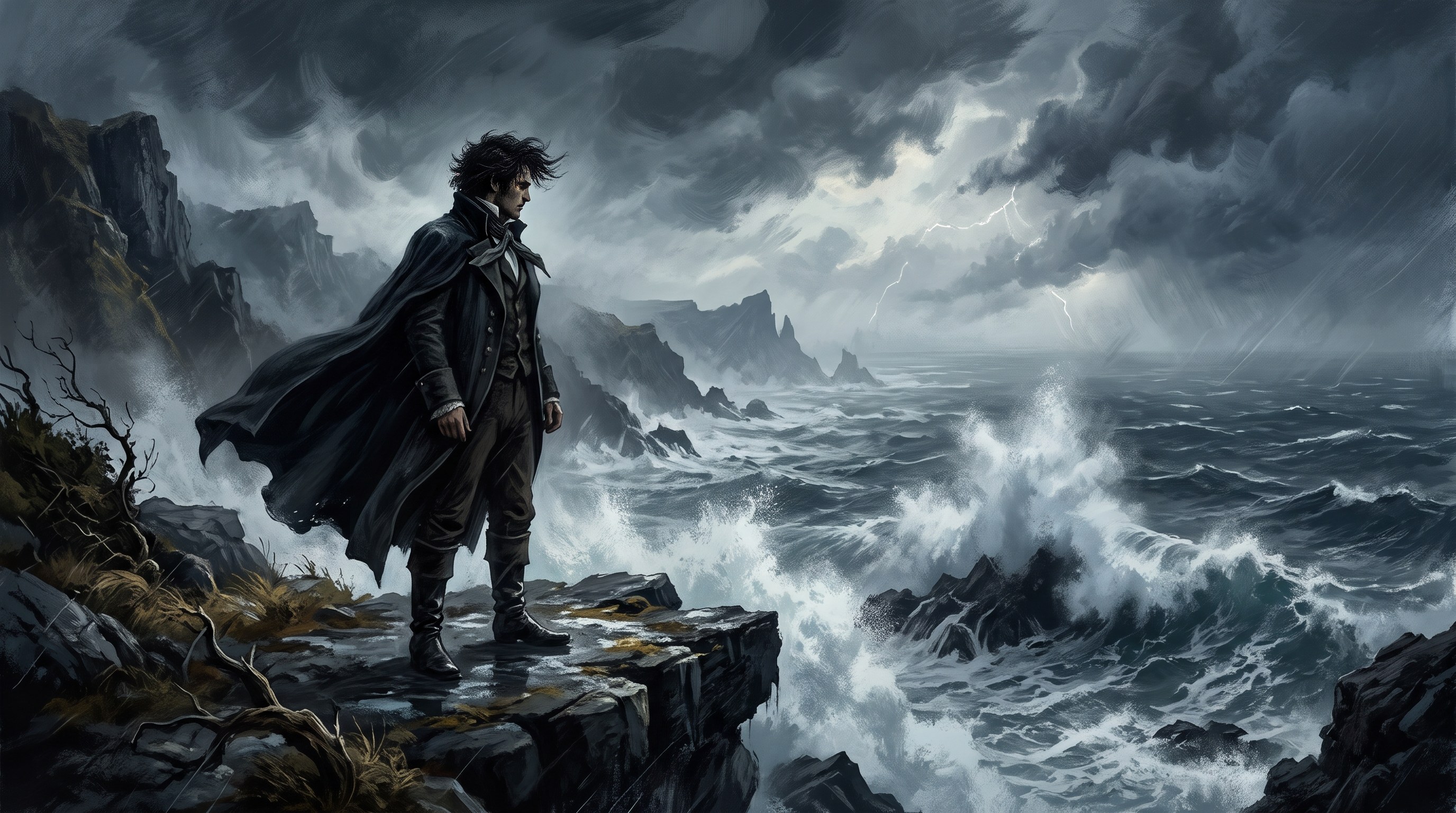
This is a crucial concept. The sublime is a feeling of overwhelming awe mixed with terror. It is what you feel when you look at a massive, dangerous mountain, a violent storm, or a vast ocean. The Romantics loved the sublime because it made humans feel small but also connected to something greater.
5. The Glorification of the Individual (The Byronic Hero)
The Romantics celebrated rebels and outsiders. They created a new type of character called the Byronic Hero—a proud, moody, rebellious, and deeply flawed character who rejects society's rules. He is dark, passionate, and often tormented by a secret past.
6. Interest in the Supernatural and the Past
Because they hated the cold, modern, industrial present, the Romantics loved the Middle Ages. They wrote about knights, castles, ghosts, and magic.
Part 3: The First Generation of Poets (The Revolutionaries)
The Romantic period officially begins in 1798 with the publication of a joint collection of poems called Lyrical Ballads. It was written by two young men who completely changed English literature.
1. William Wordsworth (1770–1850)
Wordsworth is often called the "father of Romanticism." He lived in the beautiful Lake District in England, where he spent his days walking in nature.
- His Philosophy: Wordsworth believed that nature was the greatest teacher. He believed that in our youth, we are close to nature, but as we grow older, we lose that connection. His poetry is about trying to recapture that magic.
- His Style: He rejected the fancy, complicated language of the Neoclassical writers. He wanted to write poems using the simple, everyday language of common people.
- Famous Works: Tintern Abbey (about the calming power of memory and nature), I Wandered Lonely as a Cloud (about a field of daffodils), and The Prelude (a massive autobiographical poem about the growth of his mind).
2. Samuel Taylor Coleridge (1772–1834)
Coleridge was Wordsworth’s best friend and collaborator, but his mind worked in the exact opposite way. While Wordsworth looked at a simple flower, Coleridge looked at magic and the supernatural.
- His Philosophy: Coleridge believed in the power of the imagination to create entirely new worlds. He suffered from severe anxiety and an addiction to opium, which fueled his dark, dream-like poetry.
- Famous Works: The Rime of the Ancient Mariner (a terrifying, ghostly poem about a sailor who kills an albatross and is cursed), and Kubla Khan (a magical, unfinished poem he wrote from an opium dream).
Part 4: The Second Generation of Poets (The Tragic Rebels)
The second generation of Romantic poets were younger, more rebellious, and all died tragically young. They were disillusioned by the failure of the French Revolution and turned to extreme beauty, rebellion, and tragedy.
1. Lord Byron (1788–1824)
Lord Byron was the ultimate rockstar of his era. He was famously handsome, wealthy, and scandalous. He was born with a clubfoot (a disability) but became a magnificent athlete. He had countless romantic affairs, was exiled from England due to his scandals, and eventually died fighting for Greek independence.
- His Style: His poetry is brilliant, sarcastic, and deeply cynical. He created the "Byronic Hero," which was basically a reflection of himself.
- Famous Works: Don Juan (a massive, hilarious, and satirical epic poem) and Childe Harold's Pilgrimage (a poem about a young man traveling through Europe, disillusioned with life).
2. Percy Bysshe Shelley (1792–1822)
Shelley was a brilliant, radical idealist. He was kicked out of Oxford University for writing a pamphlet about atheism. He believed in free love, democracy, and the power of poetry to change the world. He drowned at the age of 29 in a boating accident in Italy.
- His Philosophy: Shelley hated tyranny and oppression. He believed that poets were the "unacknowledged legislators of the world"—meaning that writers have the power to inspire revolutions and change society.
- Famous Works: Ozymandias (a famous sonnet about the ruin of a proud king's statue in the desert, showing that power is temporary), Ode to the West Wind (a passionate plea to the wind to spread his ideas), and Prometheus Unbound (a lyrical drama about a god who defies a tyrant).
3. John Keats (1795–1821)
If Byron was the rebel and Shelley was the philosopher, Keats was the pure artist. Keats grew up poor and trained to be a surgeon, but he gave up medicine for poetry. He died of tuberculosis at just 25 years old.
- His Philosophy: Keats believed in "Negative Capability"—the ability to live with mysteries and uncertainties without needing a logical explanation. He was obsessed with beauty and the tragic fact that all beautiful things must eventually die.
- His Style: His poetry is incredibly rich, using all five senses. You can taste, touch, and smell his poems.
- Famous Works: Ode to a Nightingale (about the pain of mortality vs. the immortality of a bird's song), Ode on a Grecian Urn (about art's eternal beauty), and La Belle Dame sans Merci (a haunting poem about a knight destroyed by a fairy woman).
4. William Blake (1757–1827)
Blake was a bit older than the others, but he was the most radical of them all. He was a poet, an artist, and a mystic. He claimed to see angels in trees and had visions. He self-published all his own books, carving the words and images onto copper plates.
- His Philosophy: Blake hated the Industrial Revolution and the strict rules of the Church. He divided human nature into two states: "Innocence" (childhood, joy, imagination) and "Experience" (adulthood, rules, corruption).
- Famous Works: Songs of Innocence and of Experience (which includes the famous poem The Tyger, asking how a good God could create such a terrifying beast), and Jerusalem.
Part 5: The Novel in the Romantic Era
While poetry completely dominated the Romantic period, the novel also evolved in fascinating ways.
1. The Gothic Novel
The Gothic novel was the dark side of Romanticism. It took the Romantics' love for the supernatural and the sublime and turned it into pure horror.
- The Rules: Gothic novels are usually set in dark, crumbling castles with secret passages. They feature terrifying villains, innocent heroines in distress, ghosts, and supernatural events.
- Mary Shelley: She wrote Frankenstein (1818), often considered the greatest Gothic novel. It is the story of a scientist who creates a living creature from dead bodies, only to abandon it in horror. The monster is the ultimate Romantic outsider—ugly, lonely, and desperate for love.
- Ann Radcliffe: The most popular Gothic writer of the time (The Mysteries of Udolpho).
2. The Historical Novel
Sir Walter Scott popularized the historical novel. He wrote massive, sweeping stories about Scottish history and the Middle Ages, feeding the Romantic obsession with the past. His most famous work is Ivanhoe.
3. The Anti-Romantic: Jane Austen
While the Romantics were writing about intense passion, ghosts, and wild mountains, Jane Austen was quietly writing brilliant comedies of manners.
- Her Style: Austen wrote about the everyday lives of the English middle and upper classes (courtships, marriages, money). She used biting irony and perfect logic. She actually mocked the extreme emotions of the Gothic novels in her book Northanger Abbey.
- Famous Works: Pride and Prejudice, Sense and Sensibility, Emma.
Part 6: The End of the Era (1837)
The Romantic period comes to an end around 1837 with the death of William Wordsworth and the coronation of Queen Victoria.
The young Romantics (Byron, Shelley, Keats) were all dead. The world was changing again. The British Empire was expanding, and the Industrial Revolution was in full swing. The pendulum was swinging back toward logic, social rules, and strict morality.
Writers stopped looking inward at their own emotions and started looking outward at society. It was time for the novel to take over. The age of the Victorian era had begun.
Quick Summary: Exam Cheat Sheet
- Time Period: 1798 (Lyrical Ballads) – 1837 (Queen Victoria's coronation).
- Historical Context: The French Revolution, the Industrial Revolution, a rejection of Neoclassical logic.
- Key Philosophies: Emotion over reason, the power of imagination, the worship of nature, the "Sublime," and the glorification of the individual (the Byronic Hero).
- The Big Writers (The Six): William Wordsworth: Nature and everyday life (Tintern Abbey). Samuel Taylor Coleridge: The supernatural and imagination (The Rime of the Ancient Mariner). Lord Byron: Rebellion and satire (Don Juan). Percy Bysshe Shelley: Idealism and revolution (Ozymandias). John Keats: Beauty and mortality (Ode to a Nightingale). William Blake: Mysticism and innocence (The Tyger).
- Major Forms: Lyrical Ballads, the Ode, the Sonnet, the Gothic Novel (Frankenstein), and the Historical Novel.
- The End: The death of the first generation, the failure of the French Revolution, and the rise of the Victorian